
The dry dropper rig is a versatile fly fishing setup that uses a dry fly and a nymph at the same time. Understanding how the dry dropper rig works allows anglers to target fish on and below the surface by suspending a subsurface nymph with a buoyant dry fly. We find this fly fishing setup to be one of the easiest and best beginner fly fishing rigs to master.
In this article, you will learn how to build a dry dropper rig, the best flies for this rig, the basics of the hopper dropper system, and the seven methods for setting up the dry dropper.
Let’s get started!
This post may contain affiliate links, meaning Slackwater earns a commission for the referral if you decide to make a purchase through the links, but your price stays the same. Even if you click through to buy flies and you end up buying a fly box, we earn a commission. We thank you for supporting Slackwater!
The Dry Dropper Rig

What is a Dry Dropper Rig?
A dry dropper setup is a simple rig where the nymph fly is suspended below a dry fly. The nymph is attached to the dry fly with a piece of tippet, ranging in size from 3x to 7x. This rig is easy to learn, quick to set up and allows anglers to catch fish in two distinct ways: above the surface and below the surface. For beginners, it is one of the first and best setups to learn when fly fishing.
This is similar to a traditional dropper rig, however a dry fly is used for an indicator rather than yarn or a bobber.

With this rig, the dry fly simultaneously acts as an indicator and an attractor pattern.
If a fish eats the nymph, also known as the “dropper fly,” the dry fly may become submerged, twitch, or move unnaturally. This movement offers the angler a visual cue that a strike has occurred beneath the surface.
If a trout takes the dry fly, it becomes a surface strike, similar to any dry fly fishing.
Fly fishers typically tie one or two nymphs to the rig. However, using only one nymph is generally best to avoid poor drifts and unwanted tangles.
Read more below about the seven primary methods for building the dry dropper setup.
Best Flies for a Dry Dropper Rig
These are our recommended flies and materials needed for a basic dry dropper rig. You’ll need dry flies, nymph flies, a tapered leader, tippet material, and floatant.
The dry flies will be used on the surface to suspend the nymph flies beneath the surface. The dry fly will be tied to the leader and the tippet material will be used to tie on the nymph fly. Floatant is used to help the dry fly ride high in the water.
See the diagrams below for more information on how to tie a dry dropper rig.
Buoyant Dry Flies


Leader, Tippet, & Floatant


What Makes Dry Dropper Fly Fishing So Effective?
Anglers love this rig because it allows them to catch fish with a dry fly and a nymph in consecutive casts without changing their rig.
On rare occasions, we’ve experienced a surface strike at the same time as a nymph strike. While this situation presents its own challenges, it can result in two fish being caught in one drift!
Rather than using a bobber indicator (which has no hook), the angler can present an above-the-surface imitation simultaneous to drifting a nymph below the surface where fish commonly feed.
The rig is also effective from the standpoint of delicacy and stealth. A dry fly, which almost always lands more gently than a bobber, will improve an angler’s chances of not spooking a fish.
This popular fly fishing rig is also unique because it allows us to literally “test the waters” for a trout’s desired feeding pattern.
If we are unsure if the fish are focused on dry flies or nymphs, we often use a dry dropper system to help eliminate the method that isn’t working.
How To Set Up a Dry Dropper Rig
This rig involves tying the dry fly to the end of the leader and then attaching a length of tippet material to the bend of the dry fly’s hook. The nymph is then tied to the tippet below the dry fly. See the diagrams above for reference.
An angler will apply floatant to the dry fly to help it achieve maximum buoyancy.
Other forms of this setup involve tying the tippet to the eye of the dry fly or on a tag. Although in its simplest form, most people tie it to the bend of the hook.
7 Dry Dropper Rig Setups
Here are the seven primary methods for setting up a dry dropper rig. There is no one right way to set this rig up, however some methods are easier and quicker than others.
Method 1: Single Dry Dropper From Bend of Hook

A single dry dropper tied off the bend of the dry fly’s hook is the more simple, beginner friendly setup. It involves using only one dry fly and one nymph fly, attached by a singular piece of tippet.
Advantages of the single dry dropper include the angler’s ability to build the rig quickly and change elements of it easily (i.e., change out flies or adjust the depth of the dropper nymph).
Method 2: Double Dry Dropper

The double dry dropper rig simply adds an additional nymph to the subsurface system. Often times, the bottom fly, also knows as the point fly, will be a heavier or larger than the first fly in the system. The heavier point fly helps both nymphs sink quickly to get in front of subsurface fish. The two flies are tied in line with each other, rather than with a tag.
Advantages of the double dry dropper include the ability to cover more sections of the water column. Disadvantages of this system include the probability of more snags and tangles. Additionally, it takes longer to set up than a single nymph system.
Method 3: Double Dry Dropper With Tag

This double dry dropper method includes using a tag to tie the first fly. One advantage of using a tag allows the angler to drift the first fly more naturally through the water than with an in-line system, as discussed above. A tag is often used in dedicated nymph rig systems, and is a very effective way to present a fly naturally.
Disadvantages of the tag system include the high probability of intense tangles and wind knots. We advise the tag system to only be used in a dry dropper rig when an angler has extremely proficient casts and hook setting skills. Otherwise, we recommend sticking to a standard single or double nymph system.
Method 4: Single Dry Dropper with Drop Shot
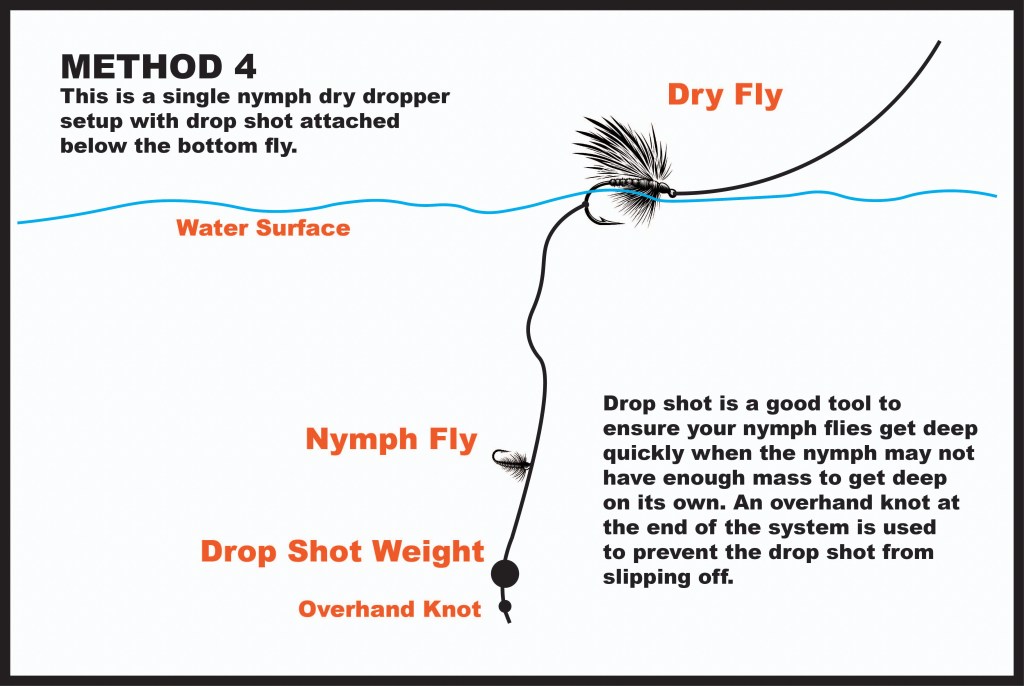
Adding drop shot to the end of your nymph system can be an effective way to ensure your nymph gets deep quickly. Drop shot, also known as split shot, is a material anglers crimp on to their fly line to help get their nymphs deep quickly.
Advantages of using drop shot include the angler’s ability to more accurately target the bottom of the river. Downsides to using drop shot with a dry dropper system include the possibility for more tangles in addition to the extra weight pulling on the dry fly too much.
If you’re using drop shot in this system, we advise you to use an overly buoyant dry fly to suspend the extra weight.
Method 5: Tying Dropper to Eye of Dry Fly
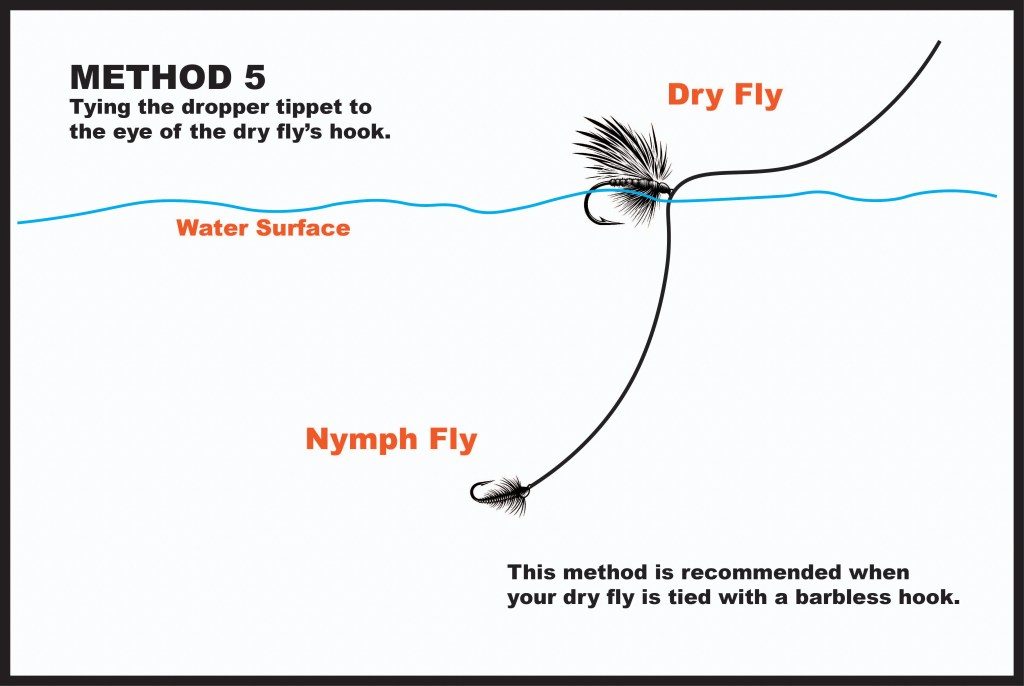
This method of a single dry dropper rig involves tying the dropper tippet directly to the eye of the dry’s hook, rather than its bend. It is a popular system to use when the dry fly is barbless.
Method 6: Dry Fly Tied On a Tag
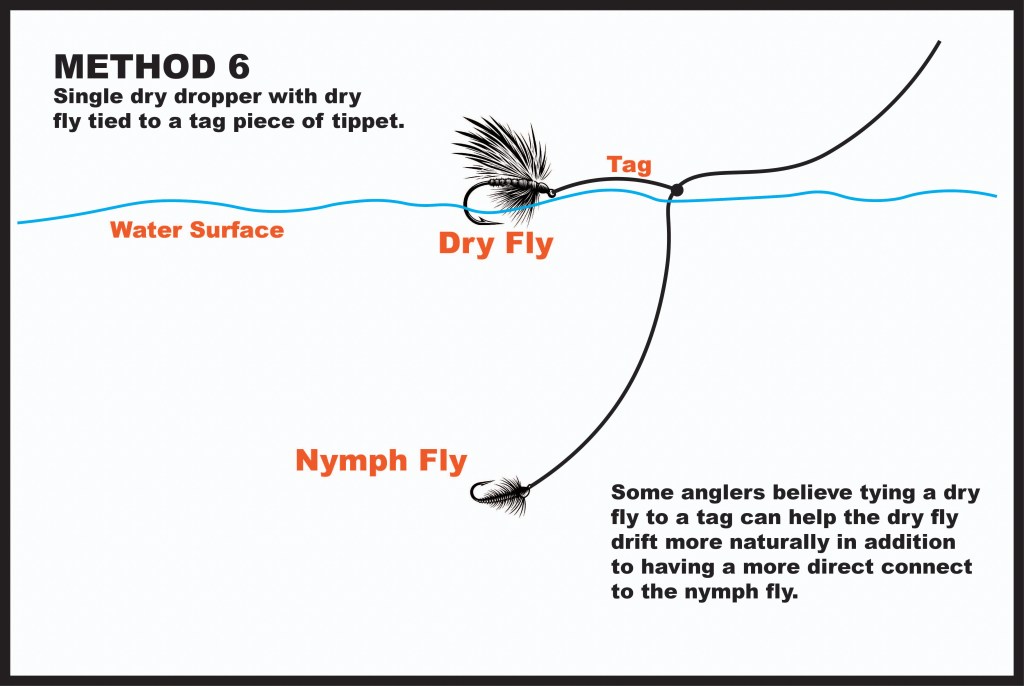
As discussed throughout this article, there are inherent disadvantages of the dry dropper rig, including an angler’s inability to drift the dry fly AND the nymph fly in a perfect manner. Either the dry fly imposes drag on the nymph, or the nymph fly will impose drag on the dry.
Tying the dry fly to a tag will help alleviate some of these issues as it allows the dry fly to (theoretically) float naturally.
However, there are some disadvantages to this system, including the time it takes to build a tag into your system. We recommend this method for advanced anglers who are familiar with tags and skills to build their rigs quickly.
Method 7: Free Moving Dry Fly Between Knots

This is another more complex dry dropper rig that involves the dry fly moving freely between two double surgeon’s knots, one above and one below the dry fly.
In theory, this system can work if the double surgeon’s knots are large enough to not slip through the eye of the dry fly’s hook. However, it is quite cumbersome to build, and we feel like other methods of the dry dropper rig can be equally as effective.
Here’s a short video from Orvis detailing how to set up the dry dropper rig:
Types of Knots & Length of Tippet
A standard clinch knot or improved clinch knot can be used to tie the tippet to the bend.
The length of the tippet used will help determine how deep the nymph fly can sink and drift. Tippet size can range from 3x to 7x, depending on the application. In most cases, 5x tippet will be the best for this system.
Generally, the dropper fly should be between 18 and 36 inches below the dry fly. However, there are always exceptions, which we will discuss below.
It’s important to remember that the length of the tippet does not necessarily equate to the exact depth at which the nymph fly will sink, but instead, the maximum depth at which it can sink.
The depth to which the dropper fly will effectively drift depends on the fly’s weight, the length of the angler’s drift, and the speed of the currents.

Categories of Dry Dropper Setups
Two types of dry dropper fly fishing include the light dry dropper and the bobber dry dropper.
- Bobber Dry Dropper
- Light Dry Dropper
Both fly fishing techniques are effective in their own ways.
The Bobber Dry Dropper
The bobber dry dropper rig is the most common of the two setups. Although its name indicates it involves using a bobber-indicator, there is no bobber involved.
Instead, the dry fly is used as a bobber, and the angler focuses on achieving a perfect drift for their nymph.
In other words, the nymph is the top priority, and the dry fly comes second.
The dry fly will typically be larger (size 8-12) and have enough buoyancy to suspend heavier dropper flies. The distance between the dry and nymph can be short or long, ranging from 18 to 48 inches.
The angler’s goal with this setup is to fish the nymph directly below the dry fly in a perfect dead drift. This goal is possible because the subsurface fly will be heavy enough to swiftly cut through the currents and arrive in the strike zone directly under the dry.
Downsides of the Bobber Dry Dropper
The nature of a heavy nymph on a long tippet will increase the chances of unwanted drag on the dry fly. Hence, the dry fly will act more as an indicator (aka bobber) than a dry fly due to its inability to get a perfect dead drift.
The benefits of this setup include the ability to land your rig more gently on the surface compared to an actual bobber setup but still fish the rig into deeper runs.
The best dry flies for this rig include larger flies such as the Chubby Chernobyl, Stimulators, or any hopper patterns.
Nymph flies can be large (size 10-14) and heavy. Popular patterns include nymphs with bead heads or tungsten jig patterns. One of our favorite heavy patterns is the Mop Fly.
If lighter, more realistic patterns are required, anglers can add drop shot to their system or fish the Light Dry Dropper setup.
The Light Dry Dropper
The light dry dropper involves fishing with lighter, more realistic flies and better presents the dry fly naturally. Hence, this rig allows the angler to focus on the dry fly first and the nymph second.
The length of tippet between the dry and dropper fly will be shorter, ranging from 8 to 24 inches.

Because the nymph will not have any significant weight and is tied on a shorter piece of tippet, its effect on the dry fly’s drift will be minimized. A tippet section any longer than 24 inches will increase the chances of the nymph landing in a different current, resulting in a killed drift for the dry.
We like using a light dry dropper in the spring and fall when flows are lower, and anglers can utilize smaller dries and lighter nymphs.
This rig is best used when fish are feeding close to or on the surface.
Another benefit of the light dry dropper is that the dry fly doesn’t have to retain significant amounts of buoyancy. The dry should be whatever fish are eating that day, regardless of size, and the nymph can be anything light that looks natural to the fish.
Dry flies could include mayflies, caddis, or small stimulators of varying sizes. Remember, they don’t have to be incredibly buoyant—just buoyant enough to gently suspend a light, natural-looking nymph.
Nymphs could be small mayfly and caddis nymph patterns, such as pheasant tails or hares ears (size 16-18). Or any type of emerger fly pattern will work well, such as an RS2 or Barr’s Emerger.
The Hopper Dropper Rig
The hopper dropper rig is a dry dropper fly fishing subset and generally aligns with the light dry dropper profile.
The main difference between the hopper dropper setup and other dry droppers is that it specifically uses a hopper pattern as the dry fly.
Otherwise, it is similar to all other types of dry dropper fishing because it simultaneously fishes two parts of the water column.
To set up a hopper dropper rig, tie a dropper pattern to the end of your leader, attach a 12-24 inch piece of tippet to the bend of the hopper’s hook, and attach the nymph to the end of the tippet below.
The best flies for a hopper dropper rig include a Chubby Chernobyl, a Dave’s Hopper, or a Morrish Hopper.
Because most hoppers have a decent amount of buoyancy, anglers don’t have to strictly use lighter, more natural nymphs with this rig. Using a nymph with a hook in the 12-18 size is perfectly fine. Further, it can have a small amount of weight if necessary.
Hopper dropper setups perform excellently when cast towards undercut banks or near shore, where grasshoppers and other terrestrial insects may fall into the river.
After flows have peaked and terrestrial insects are everywhere (usually late June into August), the hopper dropper setup is a great fly fishing technique.
Determining Depth For Dropper Fly
The length of the tippet (i.e., how far the nymph is dropped) depends on whether you’re fishing a bobber dry dropper rig or a light dry dropper rig.
The bobber dry dropper setup is the most common form of dry dropper fishing, involving tippet lengths between 18 and 48 inches.
As a rule of thumb for all dropper-style fly fishing, the length of the tippet between the dry and nymph fly should be 1.5x the river’s depth.
For slower-moving water, an angler may adjust it to 1.2-1.3x the depth. Or for faster water, extending it to 1.8-2x the depth is not unreasonable.
Remember that the longer the tippet section, the less control of the drift you’ll have.
Negatives of Dry Dropper Fly Fishing
While the rig can be an incredibly effective method of fly fishing, it also has some downsides.
- The more advanced angler will note the dry dropper rig prevents them from getting a perfect drift on both flies. This doesn’t mean that it isn’t an effective method of fly fishing, but you do give up some effectiveness compared to single dry fly fishing or tight-line nymph fishing.
- It is more cumbersome to change depths. To fish deeper or shallower, you must break knots and re-tie flies. When using a traditional bobber indicator, changing depths can be seamless.
- Tangles can happen frequently without an excellent cast or with too many false casts. To decrease your risks of tangles, use simple roll casts and eliminate too many false casts.
- A two-fly rig may be enough to spook the fish in shallow and clear water. We recommend fishing a single dry rig if you are spooking fish with this rig.
- The inability to fish a heavy nymph setup. If drifting two or three nymphs is necessary, a traditional bobber-indicator rig will be more advantageous.
Best Timing for Dry Dropper Fly Fishing
Our favorite time of year for dry dropper fly fishing in Colorado is the middle of spring, late summer, and early fall. Water will be lower on most streams, and the mid-day bite can be predicted on and below the surface.
This window includes most of April and the early stages of May. In the fall, it can begin around the end of July and last through October.
We prefer indicator nymph rigs or a tight-line nymphing methods over a dry dropper rig when water is high and fast in late May and most of June.
Some of the reasons this rig won’t work as well during periods of high and fast water include:
- It’s challenging to fish a deep or heavy dry dropper rig effectively.
- More turbid water will saturate (or sink) your dry fly quickly.
- Finding the right depth can be time-consuming and inefficient.
Best Trout Streams for Hopper Dropper Fishing
Small to medium-sized streams and creeks provide the most consistently good dry dropper fly fishing. However it’s still possible to be successful with a dry dropper on large rivers, depending on flows and the time of year.
We tend to favor smaller waters, however, due to these streams’ minimal complexity and depth, allowing us to fish shorter rigs.

Tailwaters that don’t vary in depth as much throughout the season are also great places for dry dropper fly fishing. Many of Colorado’s best tailwaters have consistent flows for weeks (or months) on end, resulting in predictable depths and trout holding patterns.
Freestone rivers can also be good, but it is important to note that freestone rivers rise and fall all day, making it more difficult to predict the water’s depth and the trout’s behavior.
On larger rivers, dry dropper rigs can be effective when fish are visibly feeding on the surface or near the surface.
Conclusion
We love using the dry dropper rig for many reasons, including its versatility and its ability to fish simultaneously on and below the surface. Further, the rig is easy to learn and simple to set up, making it one of the best fly fishing setups for beginners.
While the rig has inescapable downsides, the dry dropper remains a top angling technique that all fly fishers should learn and practice.
Thanks for reading,
Team Slackwater
Are you new to fly fishing? Do you need help finding the right beginner gear?
Look no further than Slackwater’s comprehensive guide to the best fly fishing gear for beginners. We believe that the best fly fishing gear should be of high quality but rarely do we need the most expensive equipment to get the job done.
Check out our Ultimate Guide to Beginner’s Fly Fishing Gear for more information on WHAT YOU NEED to get started fly fishing.
Shop for the best beginner fly fishing gear
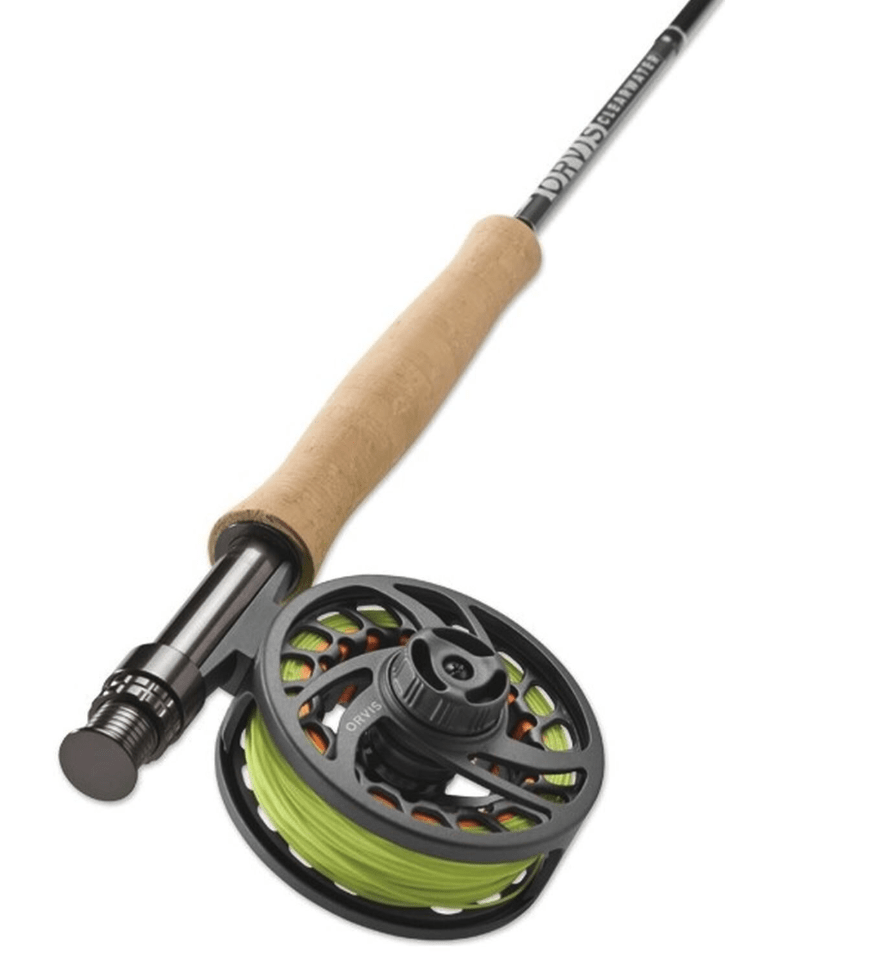
Orvis
Clearwater Combo

Simms Freestone Pack
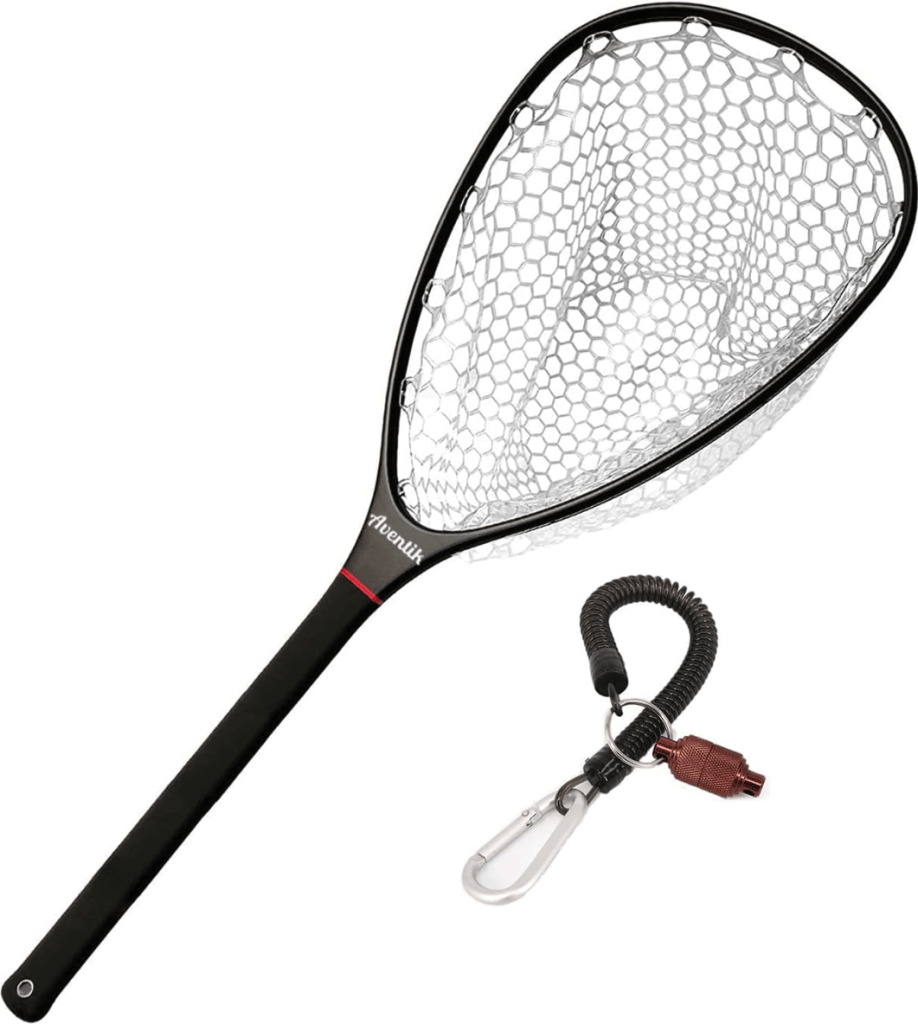
Aventik Floating Net
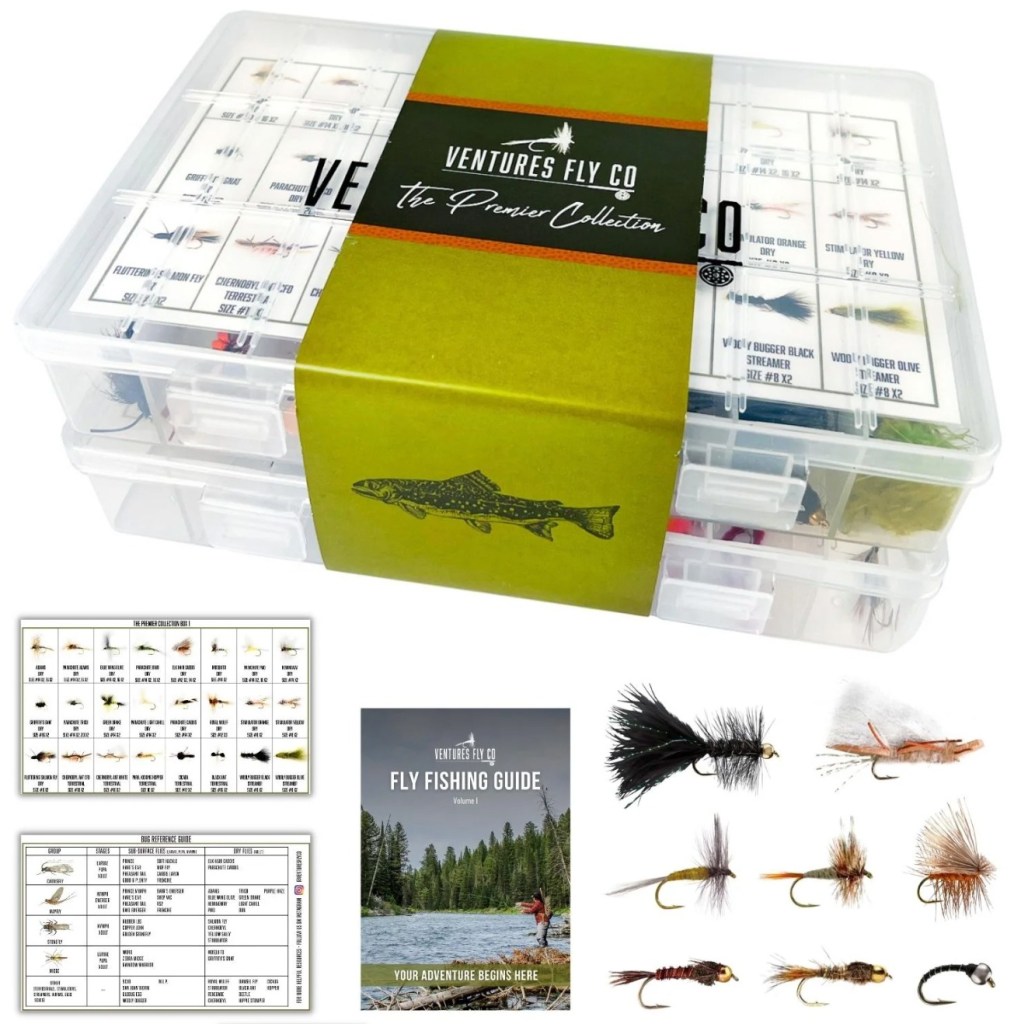
Ventures Fly Co Assortment
Orvis Clearwater Waders
