This post may contain affiliate links, meaning Slackwater earns a commission for the referral if you decide to make a purchase through the links, but your price stays the same.
Even if you click through to buy hooks and you end up buying a fly rod, we earn a commission. We thank you for supporting Slackwater!
In this article, we will discuss the best hooks for trout fishing with a fly rod.
A crucial aspect of being a great fly fisher is selecting the best hook size for trout. This is especially true when fly fishing for trout, as they are quite selective when choosing their next meal. In this article, we will discuss the best hook size for trout fishing, the anatomy of a fish hook, recommended flies for angling in Colorado, a trout hook size chart, and more!
Understanding trout hooks and picking the best hook size can significantly influence your success rate and improve your angling game.
While a size 14-16 hook is often heralded as the most versatile, the ideal hook size for trout fishing is influenced by several factors, including the tactic of fly fishing, the season, the hatching insects, and the size of the trout being targeted.
Let’s dig right into all you need to know about choosing the best hook size when fly fishing for trout.
Where to Buy Fish Hooks?
For the best hooks for fly tying, we recommend checking out the selection at Trident Fly Fishing. With their vast selection of hook styles for fresh and salt water, small and large game, as well as dry fly, nymph, and streamer hooks, you won’t go wrong shopping at Trident.


How Are Fish Hooks Measured?
When discussing the size of a hook used for trout fly fishing, it’s imperative to clarify a common misconception: the number denoting the fly’s size does not indicate the size of the fly itself.
Instead, it refers to the size of the hook the fly is tied on.
Further, as the number increases, the hook size decreases. Thus, a size 20 hook is notably smaller than its size 16 or 18 counterpart. The sizes of a fish hook are best illustrated in our fishing hook size chart, below.

Trout Hook Size Chart
Below is a trout fishing hook size chart, with the general dimensions of each size hook and a few flies representative flies.
The shank length represents how long the hook is. The gap width represents the distance between the hook’s shank and its point. Read more about the parts of a fish hook further along in the article.
The smaller the hook, the smaller the fly tied to it. Throughout the year, we will use various sizes of flies/hooks to best represent what trout are eating in their natural environment. Click on the links in the Flies Recommended for examples of what type of flies would be tied on the corresponding sized hook.
| Hook Size | Size Description | Shank Length | Gap Width | Flies Recommended |
|---|---|---|---|---|
| 26 | Tiny | 6.5 | 3.5 | Midges |
| 24 | Tiny | 7 | 4 | Midges, Spinner Dries |
| 22 | Small | 8 | 4.5 | Midges, Small Nymphs, Small Dries, Spinners |
| 20 | Small | 9 | 5 | Common nymphs, Common Dries, Midges |
| 18 | Medium-Small | 9.5 | 5.5 | Common nymphs, common dries, small terrestrials |
| 16 | Medium | 10 | 6 | Common nymphs, common dries, small terrestrials |
| 14 | Medium | 10.5 | 6.5 | Common nymphs, Common Dries, Terrestrials |
| 12 | Medium-Large | 11 | 7 | Med-Large Nymphs, Large Mayfly/Caddis, Terrestrials |
| 10 | Medium-Large | 11.5 | 7.5 | Large nymphs, Large Mayfly/Caddis, Terrestrials |
| 8 | Large | 12 | 8 | Large Nymphs, Terrestrials, Very Large Dries, Streamers |
| 6 | Large | 12.5 | 8.5 | Very Large Nymphs, Very Large Dries, Streamers |
| 4 | Large | 13 | 9 | Very Large Nymphs, Streamers |
| 2 | Extra Large | 14 | 10 | Streamers |
Where To Buy Flies for Fly Fishing?
Trident Fly Fishing is hands down our favorite place to buy flies, hooks, and other fly fishing accessories. Their large selection of dry, nymph, streamer flies for trout is second to none. Trident sources their flies from premier fly tiers and offers them to buyers at an affordable price. For the best selection of flies for targeting trout, choose Trident Fly Fishing.
Does Hook Size For Trout Fishing Matter?
The hook size you choose for trout fishing absolutely matters. Although the best hooks for trout fishing will vary depending on the type of fly fishing you’re doing.
While there’s always an exception, for most Colorado fly fishing applications, anglers fish with flies tied on hooks within the following ranges:

Remember, the larger the number, the smaller the hook. For example, a size 4 hook is bigger than a size 6 hook. And a size 22 hook is smaller than a size 18 hook. Refer to the trout hook size chart above for details on the exact sizes of fish hooks.
In general, the size of the fly should match the size of the real insects in the air and water. Some people will tell you a nymph hook needs to be small. In some circumstances, they are right. Other times, a large hook works just fine.
During certain times of the year, we will fish with size 10 Pat’s Rubberlegs because trout are keying in on large stoneflies. Later in the summer, they will only eat Rubberlegs in sizes 14 and 16, which are much smaller.
This sentiment is the same for dry flies and streamers; it’s best to choose your hook/fly size combo by matching it to the insects in the fish’s environment.
Can You Tie a Large Fly on a Small Hook?
It is possible to tie larger patterns on smaller hooks, but it is more common for the amount of material used to match the size of the hook.
Conversely, it is uncommon and not recommended to tie a small pattern on a large hook.

Instead, the hook size should be relatively indicative of the size and amount of material used to tie the fly.
Flies are designed to appear realistic to a hungry trout; thus, it’s important that the material used disguises the metal hook but leaves enough of the hook uncovered to set it in a fish’s mouth successfully.
How to Choose The Best Hook Size for Trout Fly Fishing?
The size and shape of a hook’s shank and gap (see more about the anatomy of a fish hook, below) should match the size and shape of real insects in a fish’s environment.
Therefore, one of the best ways to choose a fly/hook size is by examining what is happening below and above the surface.
Under the surface, pick up some rocks and examine the underside for crawling aquatic insects. With the exception of larger insect species such as stoneflies, you’ll likely notice that subsurface insects, aka nymphs, will be in the size 14-22 range.
If you spot a stonefly (which looks like an alien-esque scorpion), those can be in the size range of 8-16.
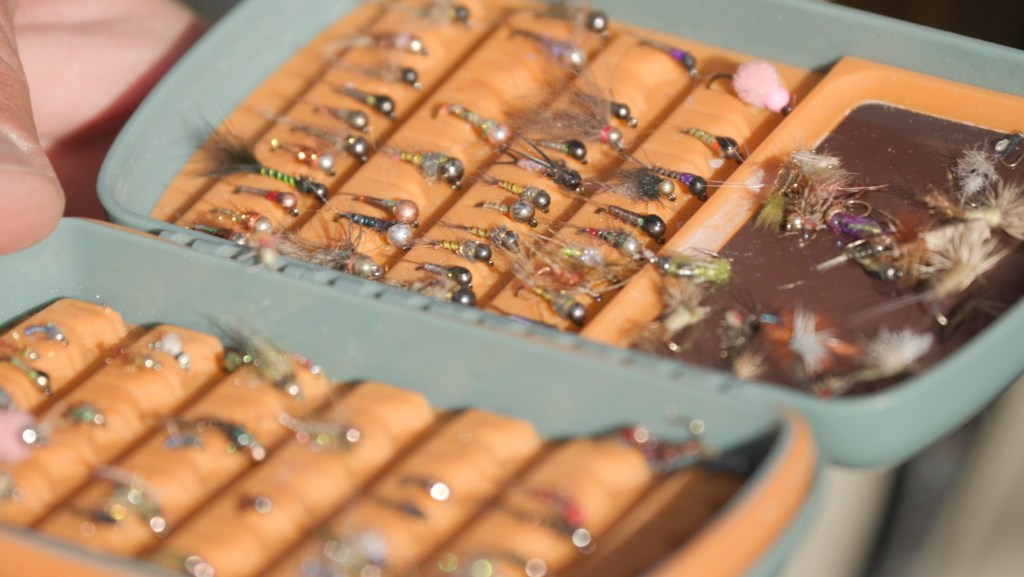
Above the surface, watch for insects flying around. Most of the flying aquatic insects in Colorado trout streams are either a version of a Mayfly or a Caddis fly.
For the bulk of the year, mayflies will be in the 14-20 size range, and caddis flies will be in the 14-18 size range.
A size 16 nymph will give you a good chance to catch a trout below the surface; however, don’t be afraid to size up to a 14 or size down to an 18 if the fish aren’t biting.
During a few special weeks when large Drakes (a larger variation of the mayfly) are hatching, you may choose a mayfly imitation in the size 10-14 range. Catching a trout on a Green Drake imitation is one of the most fun things an angler can experience!
If you are fishing with terrestrial patterns (such as grasshoppers, beetles, or ants), do your best to match your fly to the size of insects you observe crawling and on the ground.
Hoppers throughout Colorado can range from size 10 to 16, while beetles and ants will most often be in the 14-18 size range.
When we match the size and characteristics of our fly choice to the real insects we observe, it is called matching the hatch. Read more about matching the hatch here.
What’s The Best Trout HOOk Size For Colorado?
Below is a list of some of the most popular flies and hook sizes for trout anglers will use when fly fishing.
It’s common for anglers to carry a variety of flies everywhere they go. But we’d argue if your fly box is full of these recommended flies in various sizes, you’re guaranteed to catch fish.
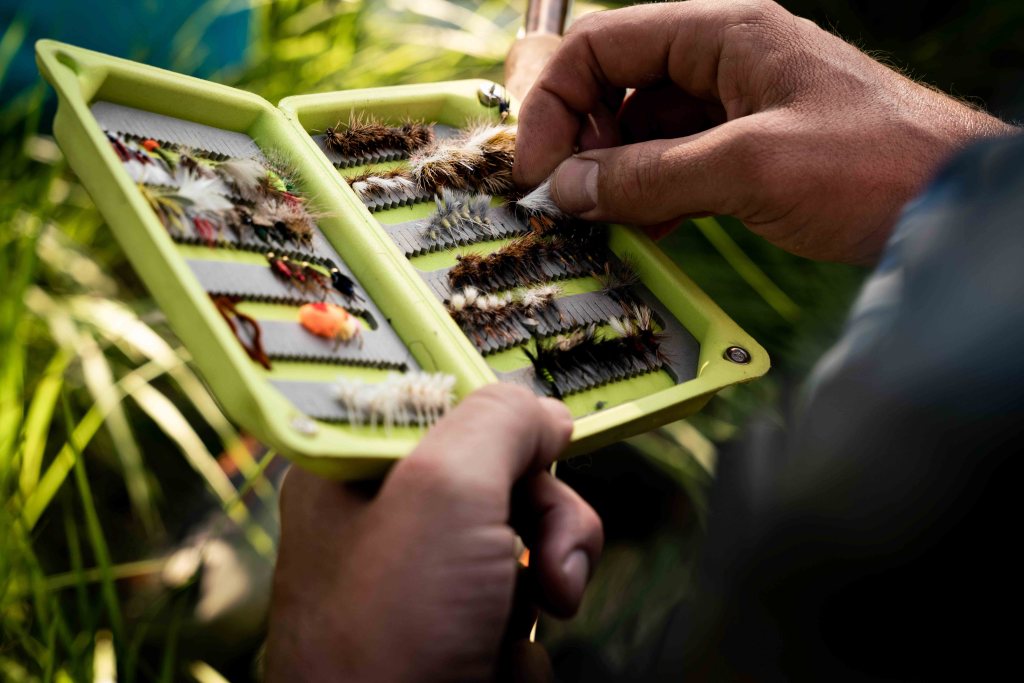
Remember that the fly’s exact size, shape, and color may vary from river to river and often depend on the time of year. It’s best to have each fli in a couple of different sizes to best match the hatch.
Best Size & Style of Dry Flies
- Size 10-14 Chubby Chernobyl
- Size 12-18 Parachute Adams
- Size 12-16 Elk Hare Caddis
- Size 14-18 Pale Morning Dun
- Size 14-18 Blue Winged Olive
- Size 12 Green Drake
Best Size & Style of Nymph Flies
- Size 14-18 Copper John
- Size 12-16 Hares Ear
- Size 14-18 Pheasant Tail
- Size 18-22 Zebra Midge
- Size 18-24 Black Beauty
- Size 14-18 Prince Nymph
- Size 18-20 Egg Pattern
- Size 14-18 Perdigon
- Size 10-16 Mop Fly
Best Size & Style of Streamer Flies
- Size 8-12 Egg Sucking Leech
- Size 8-10 Wooly Bugger
- Size 4-8 Sculpin
- Size 6-10 Muddler
- Size 2 Fathead
Best Fly Fishing SetUps for Colorado
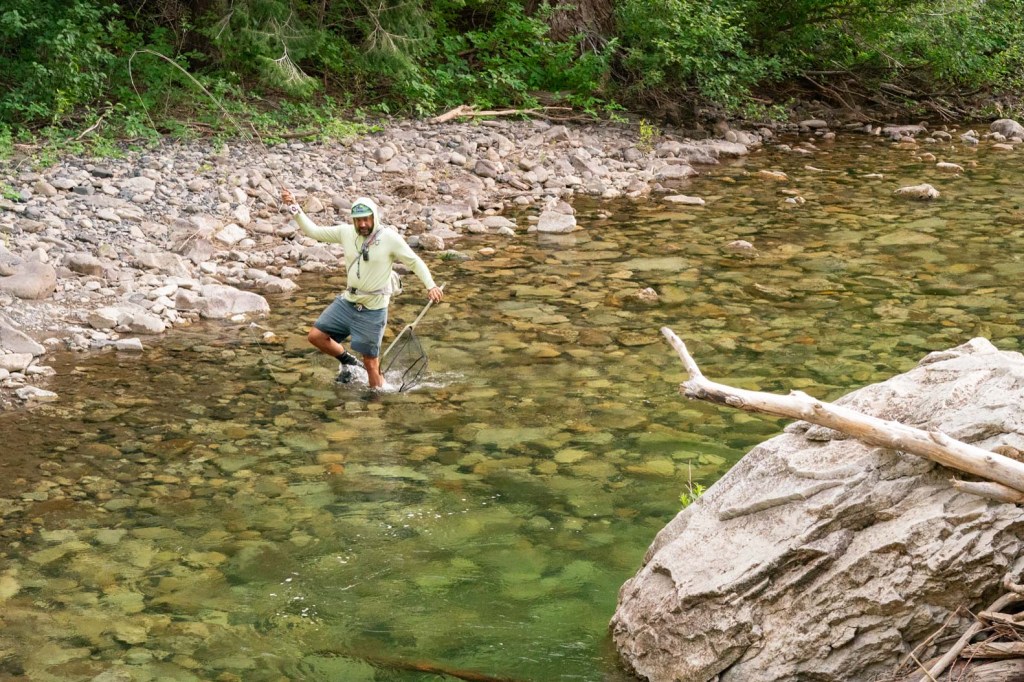
In Colorado, many people use a dry dropper rig where a dry fly floats on the surface, suspending a nymph fly below the surface. When using this rig, the dry fly must be buoyant enough to suspend the nymph fly naturally.
One of our favorite rigs when fly fishing near Crested Butte, Colorado (where we call home) is a size 14 Chubby Chernobyl suspending a size 16 pheasant tail. If the nymph fly in this dry dropper rig contains a heavy bead head, we’ll often increase the size of the dry fly to a 12.
In tailwater situations (rivers that flow from a dam), fish are often accustomed to more realistic-looking flies, requiring the anglers to size down on their fly/hook selection.
One of our favorite fly combinations for a tailwater is a double nymph rig with a size 16-18 perdigon and a size 20-22 black beauty.
For most dry fly applications, a size 14-16 Elk Hare Caddis fly will do the trick when Caddis flies are present. Or when PMDs or BWOs are fluttering above the surface, size 14-18 Adams, other other mayfly pattern, can fool a trout.
When the most realistic dry fly choice is a size 18-20, we will often use a double dry fly rig with a larger dry fly (size 14-16), leading the smaller fly by 10-14 inches. The double dry fly rig allows anglers to fish smaller flies that may be harder to see.
Reference the trout hook size chart above for a better understanding of the generic types of flies that are matched with hooks.
Read more here about guided fly fishing near Crested Butte.
Can You Catch Big Trout with Small Hooks?
Catching large trout with small flies is entirely possible and often quite common. Colorado is home to several popular tailwaters that hold trout over 20 inches and are frequently caught with flies in the 18-22 size range.

Read more about the differences between tailwaters and freestone rivers here.
Some of the famous Colorado tailwaters include:
- Blue River below Green Mountain Reservoir.
- Taylor River near Crested Butte, CO.
- South Platte River west of Denver.
- Frying Pan River in the Roaring Fork Valley.
While fooling a large fish with a small fly is common, it can be challenging. Larger fish are often more experienced and generally have a keen eye for flies that don’t appear realistic. Some of the factors that play a role in an angler’s ability to land a large fish on a small fly include:
- The direction angler sets the hook.
- The size of the tippet.
- The ability to dead drift the flies perfectly.
- The drag system on the reel.
- The overall experience (or inexperience) of an angler.
What Are the Parts of a Fish Hook?
The anatomy of a fish includes six key parts: the eye, shank, bend, barb, gap, and point. See the fish hook diagram below for details on the parts of a fish hook.

- Eye: The looped end where the fishing line or leader/tippet is attached.
- Shank: The straight segment between the eye and the bend, dictating the hook’s overall length.
- Bend: The curved portion of the hook leading to the point.
- Barb: A small, sharp projection facing away from the point, designed to prevent fish from escaping. We recommend using barbless hooks whenever possible for the best catch and release practices.
- Gap: The distance between the hook’s shaft (shank) and its point is essential for determining the size of the fish it can catch.
- Point: The sharp end of the hook is instrumental in piercing the fish’s mouth.
When tying flies, the bulk of the material will be tied on the shank of the hook. The length, diameter, and shape of the shank will be different from fly to fly. This is the same for the bend and the gap of the hook.
In general, shanks that are more curved will be better for nymphs. Straight shanks are better for dry flies. And hooks with large gaps are better for flies that require lots of material, such as a streamer.
Barbs on hooks are used to help lodge the hook into a trout’s mouth. However, with the right skills and fly fishing techniques, it’s easy to land fish on barbless hooks.
Read more about hook sizes in our trout hook size chart above.
When Should You Use Barless Trout Hooks?
Barbless hooks are a big part of the fly fishing community, and we are huge advocates of them. Specifically, because we are ‘catch and release’ anglers, it’s important to do as little damage to the fish’s mouth as possible.
As such, we typically crimp the barbs off all of our flies to do better by the fish.
With the right kind of pressure and finesse, it is quite possible to net lots of trout on barbless hooks. It’s all about how much pressure you’re putting on the fish and the kind of pressure you’re using. In many cases, side pressure is the best way to bring a fish to the net.
Read more about how to catch fish with barbless hooks in these articles:
Barbed hooks can result in ripped flex and/or bleeding from the trout’s mouth. These two circumstances can decrease the survival rate of trout and ultimately cause harm to the fishery.
In instances where a trout is foul-hooked, a barbed hook will be lodged into the fish’s body or fins. Barbs especially injure a trout when they are foul-hooked.
Therefore, we advise you to use barbless hooks. Respect the fish and respect the fishery.
Are treble hooks ok for trout fishing?
Treble hooks serve only one purpose: to catch a fish that you plan on killing.
A single hook does damage to the fish’s mouth, but not like its treble hook counterpart.
Treble hooks feature three shanks soldered together to form a hook in a triangle pattern. As such, these types of hooks will lodge into a trout’s mouth in three locations, ultimately harming the fish much more than a single hook.

Because we are catch-and-release anglers, we do not recommend using a treble hook unless you plan on killing the fish to eat. It is frustrating to see anglers using treble hooks when they are releasing the fish.
If you want to release the fish, it’s best to use a single barbless hook.
Summary On Trout Hooks
With a better understanding of trout hook sizes for fly fishing, anglers can more effectively choose the size that best aligns with their objectives. In fly fishing, we are always trying to match our flies to the size, shape, and color of real insects in the environment.
As such, the best way to choose a fly is to observe the insects in the area. Look under subsurface rocks and examine what’s flying in the air or crawling on the ground.
When possible, do your best to match the hatch and choose a fly that best imitates when fish are actually eating.
If fish aren’t biting, don’t be afraid to experiment by sizing your trout hook/fly up or down.
Thanks for reading, and thanks for supporting Slackwater.
