

Summary
The Cache la Poudre River is beginning to fish well, with spring-like conditions throughout the first 10-15 miles of the canyon. There are still spots covered in snow, but the river is substantially ice-free where it gets plenty of sun.
Trout are holding in deeper runs, slow riffles, eddies, and mildly turbulent holes. Warm days with increased flows encourage the trout to come out of their winter holding patterns and (begin) to slowly show signs they’re willing to move for food.
Current Conditions
The Cache la Poudre River flows out of Rocky Mountain National Park at its headwaters. It flows north until it takes a hard turn east in the Poudre Canyon and heads to the plains near Fort Collins, CO.
There are dozens of miles of public water in the Poudre. Nevertheless, the best fishing will be in the first 10-15 miles of the canyon. It is here where water temps are warmer and there is less snow/ice covering the river.
We typically don’t have great fly fishing conditions on the Poudre until later in March or April, but the warm temps of early March have transformed the river and allowed for productive fishing to begin.

Flows have bounced between 40 and 60 cfs for about ten days, with a few anomalies of flows touching 100 cfs. We typically find the best fishing conditions on the Poudre when flows are between 100 and 250 cfs. However, the current conditions have improved fishing conditions over what we experience throughout the winter.
You can check the Poudre River Flows at this link.
There is still plenty of snow on the south side of the river (north aspects), but it does not feel dangerous to navigate. The north side of the river is substantially snow-free, and there is very little ice on the water.
How To Catch Poudre River Trout?
Where there’s one trout, there’s probably more trout. When you catch your first fish of the day, we recommend drifting your flies through the zone a few more times thereafter. That is because there’s likely more in the same location; where there’s one, there’s more. That’s because trout are somewhat concentrated right now and not spread throughout all of the river’s features.
Nevertheless, some fish are beginning to cooperate in wanting to move (a little) more for a meal.
We recommend anglers fish deeper than they think, covering deep runs, holes, and slow riffles adjacent to faster wave trains. Usually, we would not expect to see trout in riffles at this time of year.
However, this week, we found them there!
Blue winged olives (a.k.a. Baetis/BWO’s) are on the menu. Fish will take them if they appear realistic; however, the best flies are currently the ones that can get deep quickly.
This week, trout best appreciated a larger, heavier attractor pattern instead of a realistic-looking fly.

A dry dropper rig or a contact-nymphing system will work on calmer mornings. But if it gets windy in the afternoons, we advise fly fishers to switch to a traditional bobber-indicator nymph rig. The weight of an indicator rig will better help you cut through the wind.
A 10-foot 4-weight or a 9-foot 5/6 weight fly rod will be your best choice for windier days.

Yesterday was windy, so I used a small bobber-indicator. While it may have spooked a couple of fish, the trout holding deeper did not seem to mind the indicator’s presence.
The best attractor nymph patterns were a Tungsten Bead Pheasant Tail Jig and a Tungsten Bead CDC French Jig. Both flies are available from Fulling Mill.
Both of these flies are go-to patterns throughout the year and have been working well on the Poudre and rivers throughout Colorado.
Dry fly fishing is hit or miss, especially on windy afternoons. For the most productive fishing, we recommend sticking to the nymph game. Additionally, you should fish during the warmest parts of the day between 1:00 PM and 5:00 PM.
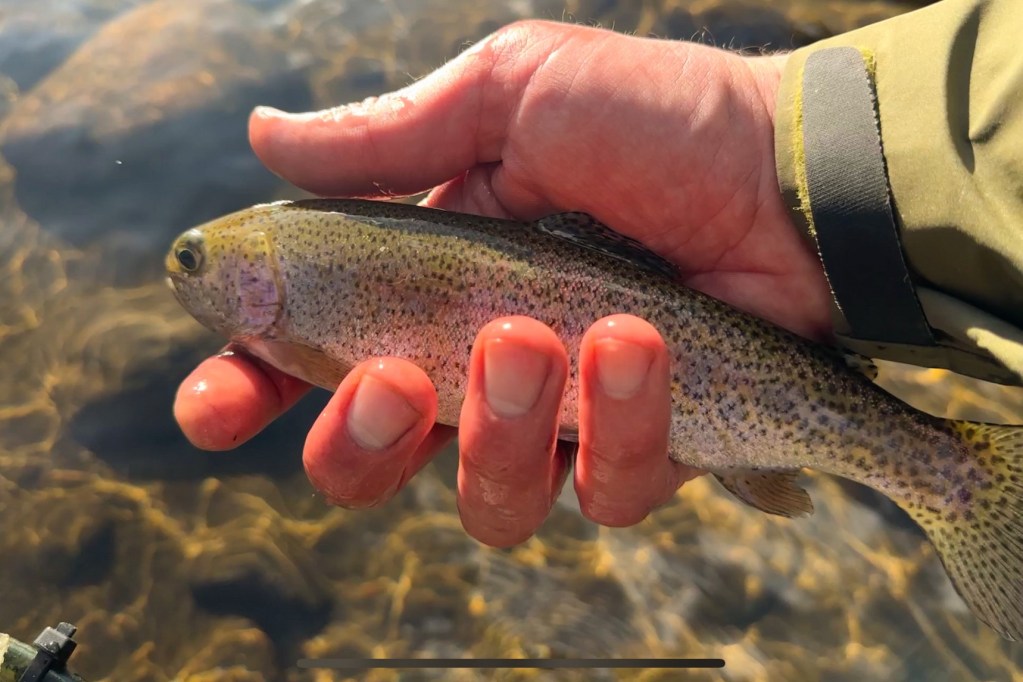
All the fish caught this week were rainbows ranging from 9 to 12 inches long. We didn’t see any larger fish or brown trout.
Short-Term Forecast
Temps are poised to remain warm until this weekend, and cooler, wetter conditions will come to Colorado next week.
Our advice is to get out there now and enjoy the warm temps while the fish are still happy!
Once the colder weather arrives for the last week of March, trout may return to semi-winter feeding patterns, meaning they’ll be more selective of artificial flies, and drifts must be more accurate.
Be on the lookout for little black stones and BWOs in the waning days of March and early April. If you see dries coming off and fish rising, feel free to throw some single dry fly rigs.
Long-Term Forecast
For some excellent fly fishing on the Poudre River, Anglers should watch stream flows to reach 100-150 cfs in early April. By then, we expect much more snow to melt and fish to be more willing to eat dry flies.
Early season (April) angling on the Poudre is one of our favorite times of year for fly fishing. The crowds won’t be there, and the trout will be hungry!

Depending on the runoff, the Poudre can be blown out by May. So get it while it’s good for the next six weeks!
Thanks for reading.