

Are you new to white water rafting and need to know what to wear? Look no further! As experienced rafting adventure enthusiasts, we’ve seen it all from sun sun-drenched summer afternoons to chilly autumn mornings to snowy winter days in a snow storm!
Through these adventures, we’ve learned that what you wear on your rafting trip can make or break the experience.
There are items you should bring that are not negotiable, and there are items you SHOULDN’T bring, that are also not negotiable (i.e. cotton clothing).
Whether you’re just starting or a fellow enthusiast, here’s a checklist of essential clothing for summer rafting.
What To Wear Rafting In Warm Weather
Here’s a list of recommended clothing for rafting trips.
- Synthetic, quick-drying base layers (no cotton clothing) such as a sun shirt and shorts
- Sturdy River Shoes (ideally closed-toed shoes or sandals with straps)
- Fleece Mid-Layer (used as a backup if you get too cold)
- Splash Gear if you tend to get cold easily
- Hat with a brim
- Sunglasses with retainer strap
Synthetic Quick-Dry Base Layers
The best base layers for rafting are made of wool or synthetic, quick-drying material. Its important to wear clothes made with fabrics that will provide warmth after getting wet.
Cotton clothing is not recommended.
Cotton stays wet for too long, retains cold temperatures, and can become uncomfortable. Conversely, wool or polyester fabrics generate heat after becoming damp or saturated. Lightweight shirts and shorts made from these fabrics are best.
If sun exposure is of concern, a long-sleeved sun hoody is a great place to start. For bottoms, wear quick-dry shorts or pants that won’t retain water for too long. Board shorts, swim trunks, or athletic shorts are good options for bottoms.

In whitewater situations, you’re bound to be soaked the entire time – it’s the nature of the sport. In casual oar-rig floating, you may not get wet but should wear clothing that will dry quickly and keep you warm should you fall in.
Our favorite base layer items are listed below:
- Sun Shirt For Men: Men’s Silkweight Hoodie
- Sun Shirt For Women: Women’s Silkweight Hoodie
- Shorts for Men: NRS Men’s Guide Short
- Shorts for Women: Oiselle Long Roga Shorts
If the weather is hot and the water isn’t too frigid, feel free to go rafting in your typical beach-style swimwear.
Sturdy Water Shoes
Slippery rocks and river beds can be treacherous. The best river shoes are designed to be wet, are close-toed, and are comfortable.
Astral makes some fantastic river shoes for men and women, including the Astral Brewer 2.0 for men and the Brewess 2.0 for women. These low-rise shoes are great entry-level rafting shoes with grippy soles.
We recommend shoes with higher ankle support and protection for heavier whitewater and extended expeditions. A rafting shoe with a higher ankle will stay secured on your feet through big swims better than the Brewer/Brewess series shoe (we can tell you from experience).
Check out the Rassler 2.0 for an excellent, mid-high ankle river shoe for men and women.
We don’t typically recommend Chacos as a good river shoe. Read on to learn more about our stance on Chacos.
Fleece Mid-Layer
We pack a fleece, even on the warmest days. And you should too.
Sometimes, we’ll wear it over our base layer and under our PFD, and sometimes, it will live in our dry bag as an insurance policy when we get too cold and wet.
The beauty of a fleece is that its synthetic fibers retain warmth when wet.
If the air temp is in the 70s and there’s limited sun, we’ll often put the fleece on to start because it’s better to be too warm than shivering. The fleece you choose doesn’t need to be expensive nor pretty.
Just make sure you have one. Learn more about the power of fleece and wool here.
Splash Gear
While not necessarily required on the warmest summer days (over 80 degrees), it’s a good idea to at least have these items handy if you or a team member get too cold.
Splash gear isn’t waterproof but instead water and wind-resistant. Splash gear provides a light barrier when things get extra splashy and can help keep people warmer.
We recommend these tops and bottoms for the most affordable splash gear clothing:
Although splash gear may have Velcro neoprene gaskets around the neck, wrists, and ankles, it isn’t dry gear. Should you swim in your splash gear, prepare to be completely soaked and cold within seconds.
Wearing a dry suit is the only way to stay dry and warm during a swim.
Hat with Brim
A good hat protects you from the sun and reduces glare, making navigating the river easier. Any ball cap or a full-brimmed hat will do. For a stylish and practical river hat, we like the hats from Hemlock Hat Co.
Remember that you won’t always wear a hat during rafting trips because you should often wear a helmet.
Sunglasses with Retainer Strap
You’ll want to shield your eyes and ensure your glasses don’t end up at the bottom of the river (which we’ve learned from experience too many times).
Chums are a great product, and so are Croakies.
What To Wear When Its Cold
Rafting in cold weather is a special adventure that is quite fulfilling but not for everyone. In addition to all of the same clothes you’d wear when rafting on a hot day, you’ll need plenty of additional insulating layers.
Because most people only go rafting when in the summer, we will only provide a simple list of cold-weather rafting items. Feel free to reach out to us at info@slackwaterco.com for a more detailed review of recommended clothing for rafting in the winter.
Clothing for cold-weather rafting includes:
- Synthetic long underwear
- Synthetic warming baselayer (wool is a good option)
- Fleece Mid-Layer
- Synthetic/wool socks
- Thin, warm hat
- Consider replacing splash gear with a wet suit or a dry suit in the colder conditions.
If you are rafting in water temps below 60 degrees and the air is also cool, we recommend wearing a full dry suit. A well-fitting dry suit will be large enough to wear several layers under it, including puffy jackets for the coldest days.
BASIC SAFETY GEAR FOR RAFTING
In addition to the basic clothes, you’ll see some safety gear.
LIfe Jacket (aka PFD) and Helmet
Wearing a life jacket, otherwise known as a Personal Floatation Device (PFD), is essential when rafting. A PFD is an extraordinarily important part of river safety because it keeps you floating should you fall out of the raft.
If you are rafting with a guide company, they will provide these safety items. If rafting on your own or with friends, ensure you’re prepared with the proper gear.
We recommend a generic whitewater-rated PFD for adult men that fits securely and meets Type III PFD standards. We like the low-profile Ninja PFD from NRS. Its simple design is comfortable and stays out of the way.
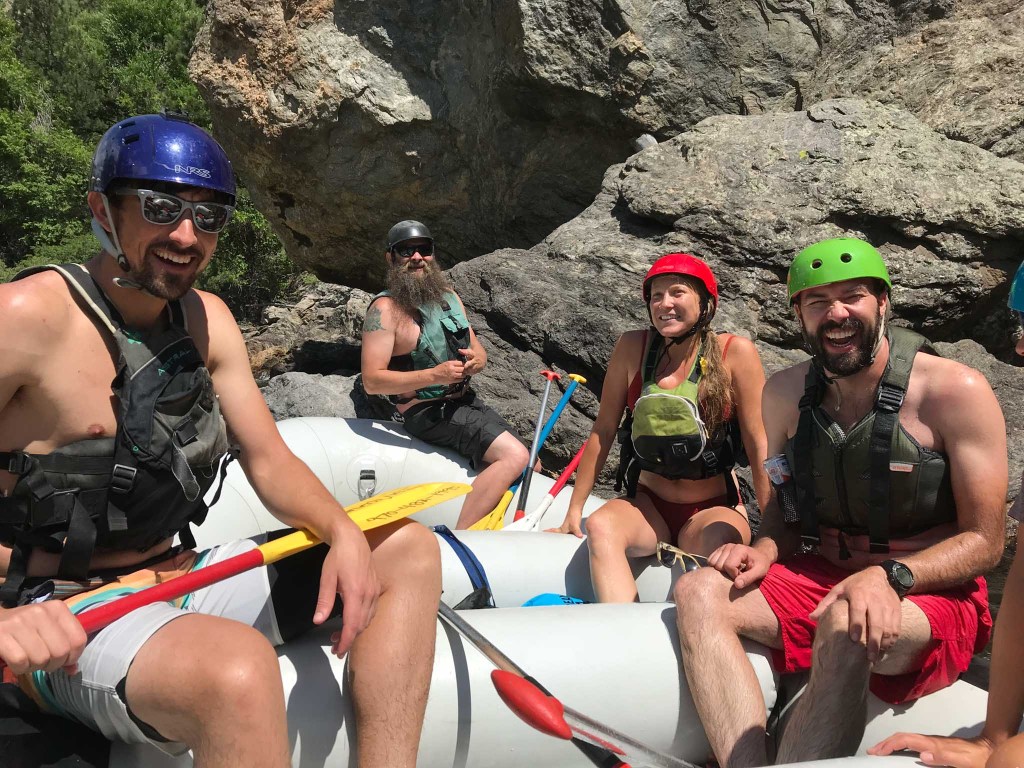
For women, get a woman’s specific model with boob cups for comfort. We like the Layla from Astral. And remember to never put a child in an adult PFD. Instead, find a kid’s PFD rated for their weight.
When going through your garage searching for the PFD you wore on a canoe trip in the 90’s, it’s important to assess if the PFD is still in good order. PFDs don’t last forever, and many will wear out over time.
We invite you to learn more about caring for a PFD as well as understand the tell tale signs that your PFD has worn out. It’s never ok to wear a PFD that has worn out.
For helmets, we like the Current and Trident from WRSI. All whitewater helmets are rated for the same protection, but the more expensive ones will most often be more comfortable and offer different features.
In the end, we recommend you as much as your budget will allow for a helmet for maximum comfort.

Are Chaco Sandals Good for Rafting?
The definitive, all-encompassing answer is: No, generally not. But like anything, it somewhat depends.
Here are our reasons why we don’t rely on Chacos as a good shoe for whitewater rafting:
- The chances of injuring your toes are high. When you get out of the raft, you’ll likely stub your toes or cut up your feet in the shrubs riverside.
- Sunburing your feet is probable: When you’re staying cool and wet, it’s easy to forget that you may be getting a sunburn on your feet.
- Chaco soles are way more slippery than a proper river shoe. If you’re on a trip where carrying gear to and from the boat is a large part of your day, slipping on the raft’s wet rubber is not fun.
- The buckle on the Chaco sandal gets caught on things: This isn’t the worst thing in the world, but we hate when ropes and other items in the raft get caught around our feet. In most situations, having stuff caught on your feet will be annoying, but in the worst situation, it can be dangerous.
So when are Chacos “okay” for rafting?
We wear Chacos rafting sometimes, but it’s never on overnight rafting trips nor in situations where there are significant rapids. For evening dinner floats on Class I and II water, we will wear Chacos.
But if Chacos are all you have, go for it!

Are other sandals ok for rafting?
Sandals are okay if you remain in the boat 100% of the time. You’ll wish you had a proper river shoe as soon as you need to stand on slippery river rocks or unintentionally become a swimmer.
Flip-flops are not a good idea.
They will likely be lost to the river in a small rapid or sticky mud. Save your flip-flops for days on the beach.

What Should Kids Wear When Rafting
Taking extra precautions when rafting with kids is essential for a safe and fun excursion. Pack extra layers for your children, emphasizing the need for non-cotton layers.
Fleeces will be your kid’s best friend on the cool, splashy days. Fleece stays warm even when wet due to is adsorption qualities of its fabric.
Remember that kids don’t have the same body mass as adults, making it more challenging for them to stay warm when wet.
A good rule of thumb for kids is to assess what you’re wearing to keep warm and then bring one extra layer. Backup insulating layers are also a good idea to have with you.
CONCLUSION
The best clothes for rafting are pieces that fit you well, are comfortable, and serve a purpose. While the list of items isn’t extensive, it’s important to become familiar with the list of essential clothing for rafting.
Thanks for reading