

Whitewater enthusiasts often come across the term “ducky” (or ducky raft) and may wonder how it stands apart from the typical inflatable kayak. To make things simple, a ducky raft is any inflatable kayak used for whitewater purposes.
While some people call them rafts, a ducky is more closely related to a kayak or an inflatable kayak, to be more precise.
Whitewater duckies come in many shapes and forms and are great for beginner or expert paddlers. Let’s dig into what a ducky boat is and how they are used.
What is a Whitewater Ducky Raft?
A ducky, at its core, is an inflatable kayak. Some people call it a ducky raft, a ducky boat, a ducky kayak, a whitewater ducky, or an inflatable ducky.
In the end, it’s all the same thing.
Crafted from robust materials akin to those used in constructing rafts, duckies are specifically designed for navigating the challenges of whitewater rapids.
Whitewater duckies are used for most of the same river applications as a raft or hard-shelled kayak. However, they are more beginner-friendly than a hard-shelled kayak and do not require rolling skills.

A whitewater duckies will be made out of PVC or lighter rafting material called Hypalon. PVC duckies are less expensive than their Hypalon counterparts; however, PVC duckies will incur more damage from UV rays and typically have a shorter lifespan.
River duckies are used to paddle through rapids, generally Class I to III, on whitewater rivers. Paddlers with advanced skills can sometimes paddle their duckies in creeks and Class IV rapids.
Duckies are similar to sit-on-top kayaks because the paddler has no cockpit. In ocean kayaking or lake kayaking applications, a sit-on-top kayak is generally made of rigid plastic.
Duckies, however, are in a different league because they are inflatable and are made from durable rubber material.
How Are Whitewater Duckies Used?
Paddlers of a ducky will sit in the boat (essentially on top of the boat), using a thwart as a backrest. Thigh straps can be attached to the ducky to provide the paddler security and more control of the boat when quick maneuvers are required.
Some duckies are tandems, meaning two people can paddle them.
The paddling strokes on a ducky are the same as those for a hard-shelled kayak, with a feathered paddle being the best choice for a paddle.
Because of the flat nature of a ducky’s hull, these inflatable boats typically cannot make moves as precise as a hard-side whitewater kayak. However, with the right skills, duckies are an excellent and forgiving whitewater option for beginners and experts alike.
Swims out of a whitewater ducky are generally simple in comparison to swims out of a hard-shelled kayak for a few reasons:
- Duckies are self-bailing, meaning the paddler doesn’t have to worry about their boat filling with water. Swims out of hard-shelled kayaks entail emptying the boat on shore before being ready to paddle again.
- Most duckies are easy to self-rescue with because the paddler can crawl back into the boat.
- Duckies generally have a few good handles that a swimmer can hold on to in situations where it’s appropriate not to be separated from their boat.
What Materials Are Best for a Whitewater Ducky?
The difference in material is stark when comparing duckies to the budget-friendly inflatable kayaks found at large retail stores.
While low-cost versions, often crafted from vinyl or other cheap plastics, are readily available, they don’t measure up to the high-quality, durable materials professional outfitters demand for their rafts and duckies.
This difference is crucial, given the propensity for encounters with sharp rocks and other hazardous objects in rapid waters.

We never recommend taking a cheap version of an inflatable kayak through rapids due to safety risks and the chance of the material not holding up.
Price often reflects quality, period. This is evident in the cost of duckies, which range from approximately $600 to $2000, compared to the $100 to $200 price tag for a standard inflatable kayak from a big-box retailer.
The more considerable investment ensures a river boat that withstands the demanding nature of whitewater adventures.
Inexpensive, poorly constructed options are not recommended for navigating challenging river sections.
The Best Duckies and Inflatable Kayaks
Some leading examples of duckies include:
Each model brings a unique blend of durability and performance tailored for the whitewater enthusiast.
As a general rule of thumb, the more you spend, the more durable the boat will be and the better features it will have.
Are Whitewater Duckies Good For Beginners?
Duckies and inflatable kayaks are excellent choices for beginners just getting into whitewater river sports.Because of their sit-on-top nature, they are comfortable, forgiving, and ride high in the water.
If a paddler swims from their ducky, self-rescue will often be relatively easy due to the self-bailing nature of these boats.
Paddling a ducky and navigating it through whitewater is a fantastic way to practice moving through a river’s conflicting currents, such as those found in strong eddy lines. Many people who want to paddle hard-shelled kayaks will start their journey learning to read water in a ducky.
A ducky can be a fun choice for expert river runners when carrying gear is essential or when simple maneuvers through whitewater are desirable.
The Difference Between Duckies and Packrafts
Duckies are significantly different from packrafts and perform much different functions.
Packrafts are designed as a lighter and more portablealternative to an inflatable kayak. They can be packed into a backpack or a small space in your vehicle and are great for human-powered adventures where weight and size matter.
Packrafts and duckies can both be paddled in splashy whitewater, but a packraft is substantially shorter, lighter, and often cannot carry as much gear.
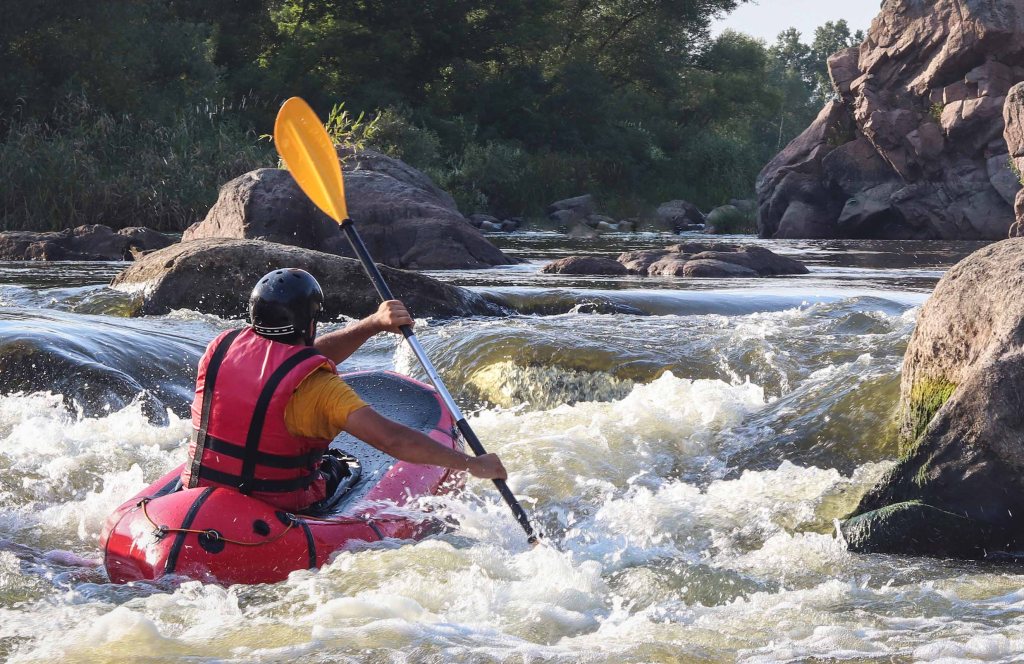
On the contrary, some packrafts with internal waterproof chambers are designed to carry enough gear for multi-day expeditions.
Packrafts are lighter and more compact, weighing between seven and 20 pounds. A packraft will take up 20 and 60 liters of space when rolled. In contrast, when deflated, ducky rafts tip the scales at 20 to 40 pounds and roll up to a volume of 90 to 120 liters.
Remember, these figures do not account for additional gear like paddles, thigh-straps, and safety gear.
Duckies or inflatable kayaks are best used when weight and size don’t matter too much. Kind of like comparing your car camping gear to your backpacking gear.
Stability and Usability of the Ducky Raft
Duckies boast impressive stability and are relatively intuitive to paddle, providing a delightful experience on the water. Paddlers often sit cross-legged or with legs extended on the inflated floor, leaning against an inflatable backrest.
We recommend sitting with legs extended and secured with thigh straps when paddling a ducky in whitewater.
Primarily designed for solo travel, some duckies can accommodate an adult with a child. If the plan is to travel with two people for long distances or a substantial amount of time, paddling separate solo duckies or a tandem ducky is advised.
Most manufacturers generally advise duckies to be used only by individuals weighing under 300 pounds.
Remember that a snug-fitting, appropriately sized PFD (aka life jacket) is required when running rivers, and helmets are advised when paddling any significant rapid.
For more information about PFDs and their lifespan, check out Slackwater’s article on What Causes a PFD to Wear Out Over Time.
The Bottom Line on Ducky Rafts
The ducky raft is not just any inflatable kayak; it’s a robust, resilient vessel designed for the rigors of paddling whitewater.
Its construction, materials, and cost all signal its specialty and suitability for adventurers seeking to tackle the more tumultuous waters safely and confidently.
Duckies are great tools for navigating rapids and are excellent choices for beginner and expert whitewater athletes.