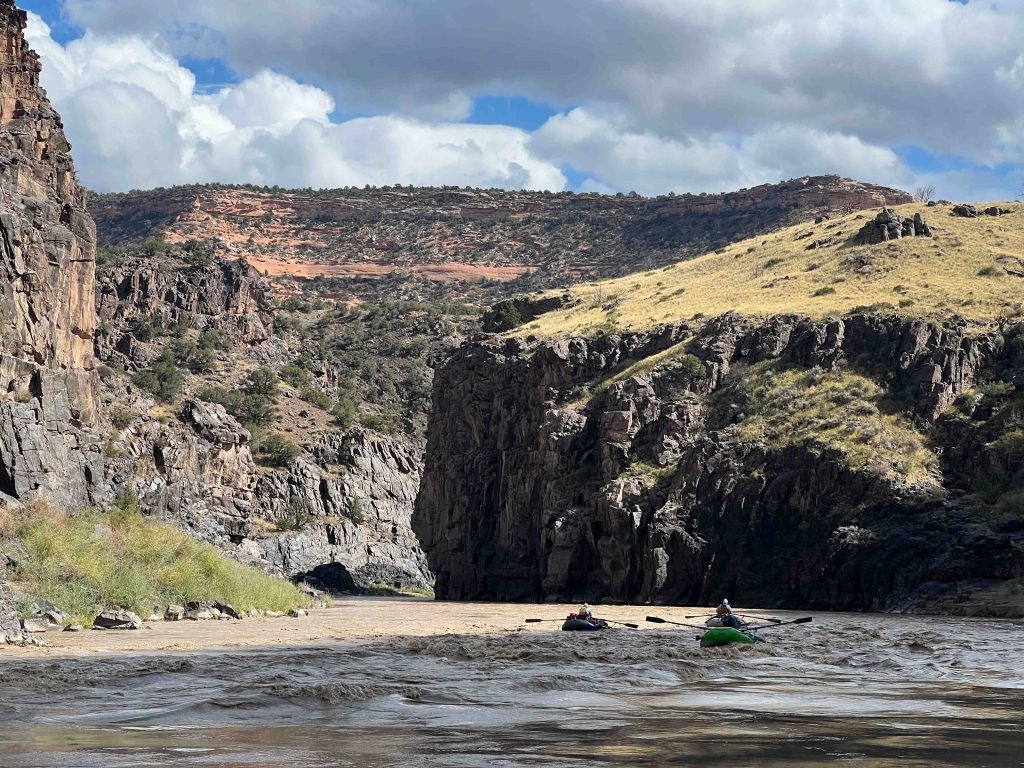
Rafting Westwater Canyon is a logistically simple, big bang-for-your-buck rafting trip near the Colorado/Utah state line.
The rafting trip begins just west of Fruita, Colorado, on the Utah side of the state line, and travels 17 miles downstream towards Moab, Utah. This trip is short and very splashy!
I had a wonderful experience rowing Westwater Canyon and would recommend this trip to anyone looking for a short trip with beautiful scenery, high-quality campsites, and plenty of exciting rapids.
The trip can be run in one day, however I believe it’s best done as an overnight to get the full experience. Having previously rafted the Grand Canyon, I found the scenery and quality of rapids in Westwater Canyon to be of high quality and comparable at times to the big water of the Grand.
Knowledge of how to read big water and execute quick and precise moves are important to having a successful trip down Westwater Canyon. Rafting Westwater Canyon is not a beginner rafting trip however the simple logistics of the trip make it easy for people new to river life to be a passenger without an extensive time commitment.
The boat I used was a single person RMR Phat Cat for which I found to be an excellent craft for this type of water and one of my favorite rafts I’ve ever used.
Westwater Canyon Rafting Trip Summary
- River: Colorado River
- Length: 17 miles
- Length of Trip: 2 days, 1 night
- Difficulty: Class III-IV, cfs dependent.
- Average Gradiant: 9 fpm
- CFS: Fluctuated between 4,100 on day one and 6,500 on day two due to heavy rain.
- Boat used: Rocky Mountain Rafts Phat Cat with an RMR Oar Frame.

Trip Details
My Westwater Canyon rafting trip began on October 2nd and finished on October 3rd, 2022. From the Westwater put in, we chose to run our own shuttle, for which takes about 1.5 hours round trip.
If you don’t want to run your own shuttle, I’ve heard a good option is American Spirit Car Shuttle. I have used American Spirit Car Shuttle for a rafting trip down Dominguez-Escalante Canyon and found them to be professional and affordable.
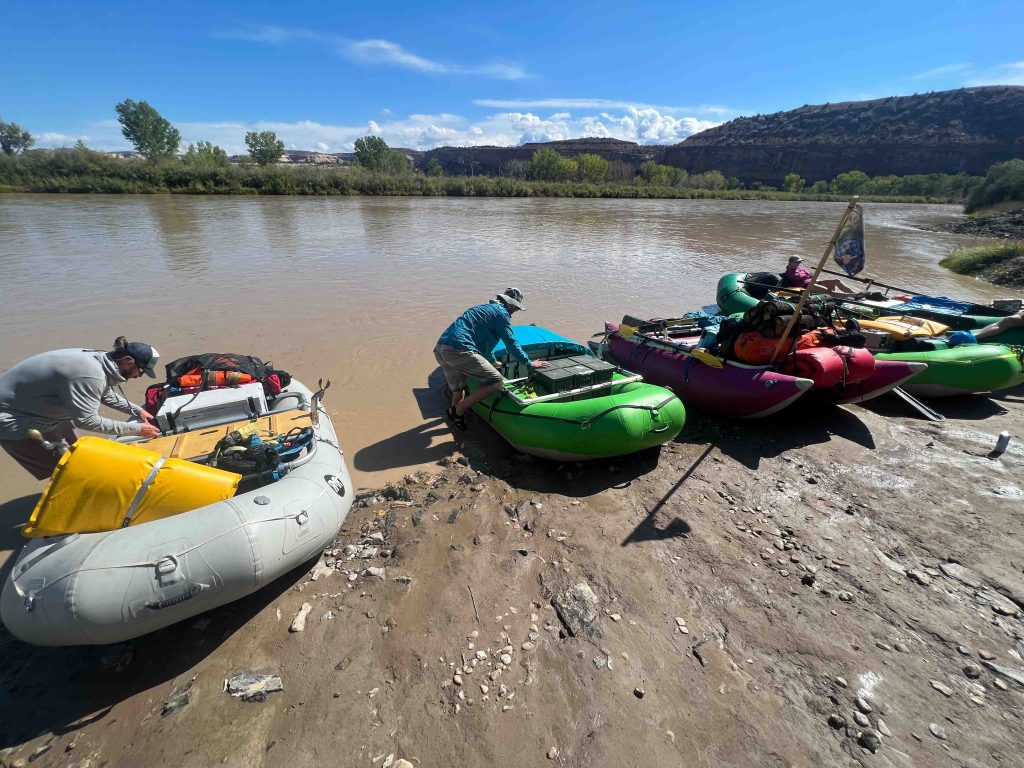
The ranger station/put-in is a relaxed area and spacious. However it is obvious how it could get congested with larger groups and/or multiple groups trying to launch at the same time.
Once we had run shuttle and the ranger checked gear, we were able to obtain our campsite permit. By the time we launched, it was 1:00 PM, making the first day on the water relatively short.
Read more about the Best Family Rafting Trips in Colorado.
At the put in, the cfs was 4,100 however we knew it was going to rise with predicted heavy rain that afternoon. The first day we stayed at the Little Dolores (Upper) campground. It was spacious and had plenty of room for our group of seven to spread out. The first six miles to Little Dolores (Upper) are almost completely flat but with stunning views of the desert landscape.
We arrived at Little Dolores (Upper) around 4:30 and quickly set up camp. By 5:30, a torrential downpour came in hot and lasted about one hour. It flooded our tent sites and kitchen area where several inches of water pooled up in the lower spots.
The rain was so heavy that waterfalls appeared out of nowhere from the canyon walls in every direction. Such a beautiful site, however also a slightly harrowing experience. The camp, as a whole, was on a relatively high point in the landscape so we did not feel nervous for our safety, but we could see how camping in a lower spot could be extremely dangerous.
Our firewood was soaked from the storm however our 20 lb propane tank fueling a blaster stove made it possible blast the wet wood with a large flame into a nice fire within just a couple minutes of time.
Pro Tip
This Woodland Power Stove heats up large quantities water very quickly and comes in handy when conventional methods of starting a fire just don’t work. Further, it is super affordable option for boiling water quickly compared to other blaster stoves on the market.

That night we had a super unique and fun dinner: A Low Country Shrimp Boil. The ingredients were simple as was the serving and cleanup.
When served on a camp table near the fire with news paper as a table cloth, your guests literally eat right at the table with their hands; plates optional. It’s quick, simple, and keeps the dish duties to a minimum thereafter. Check out this recipe for a similar Low Country Shrimp Boil while at camp. Only about 15 minutes to prep, 30 minutes to cook, and you can feed the masses with ease.
The next day, we packed up camp and rowed 11 miles. The first 2 miles included all the rapids for the trip and the excitement of the big ones did not disappoint.
We knew the water had come up from the previous day’s rain however, we didn’t know it was a full 2,400 cfs until we had cell service once again on the drive home. At 6,500 cfs, the rapids were big, the holes were meaty, and it required our full and undivided attention. I only wish I had brought my helmet mount Go Pro to capture the exhilaration and wetness!
For someone who hasn’t done this trip, there are “some” acceptable places to eddy out to scout rapids however, the eddies are not large and the egress out of the river onto dry land is not easy. The black Vishnu Schist canyon walls are tight, and the rapids are continuous through this 2-mile section. Any swims or mishaps can be consequential given the sparse number of eddies allowing self or team rescues.
It’s best to get the guidebook and allow veteran rowers to lead the way down the Westwater Canyon rapids. Find the Guide to the Colorado & Green Rivers in the Canyonlands of Utah & Colorado for an in-depth guide to rafting this stretch.

The most consequential rapid of the trip is Skull rapid for which requires varying maneuvers, depending on water level. There is a large rock center-right that at lower levels is a flipper or a dangerous sticker. At medium to high levels, this rock becomes a massive hole.
At 6,500 the rock was covered up and the pour over into the hole was quite consequential and large. At this level the rapid required a center/center-left entry with a strong and timely move to the left. Timing is crucial as if you pull left too early, you’d likely bounce off a river-left rock into the hole. If you pull to the left too late (or miss a stroke like I did), the current will push you into the hole.
I missed one of my oar strokes with a whiff and the current pushed me straight into the hole. I luckily got flushed out, although at the time I was confident I was going to flip, and barely escaped the “Room of Doom”, a strong eddy immediately following the rapid on river-right. The Room of Doom has a reputation of being inescapable at high water levels so it is advised to avoid it at all costs.
Learn more about eddy currents, and how to maneuver through eddies in this article.
The river gods were on my side that day and let me pass through Skull Rapid unscathed and rubber side down.
I drank a beer in their honor immediately after.

Summary of Rapids – Rafting Westwater Canyon at 6,500 cfs
- Little Dolores Rapid (Class III, mile 7.7): Large hole just right of center. Easily avoidable.
- Marble Canyon Rapid (Class III, mile 8.9): Wave train on river right. Simple, yet long rapid. Should be fine if you keep your boat straight.
- Funnel Falls (Class III, Mile 10): The beginning to the continuous stretch of rapids with minimal eddy opportunities. This rapid includes a fun drop and hazzards can be avoided by keeping your raft straight.
- Skull Rapid (Class IV, mile 10.7): At 6,500 cfs, the move is to enter the rapid from left of center and pull hard to the left with precise timing. Timing of your pull is crucial because you need to get past a rock on river left that can bounce you into the meat if not executed properly. In the middle of the river is a large rock that becomes a large hole at big water. At these flows, it was definitely a hole, but would be a rock with a little less water. At lower flows, a raft can squeeze between the rock and the wall on river right. Read above for the mistake I made entering skull rapid. Avoid the room of doom eddy immediately after the hole at all costs. It’s a keeper! There is a decent re-grouping eddy river left after Skull Rapid for drinking booty beers if someone swam.
- Sock-it-to-me Rapid (Class III, mile 11.1): This is a super fun rapid. Hit the wave straight and pull hard to the right to avoid the “Magnetic Wall”. T-up all waves.
- Last Chance Rapid (Class III, mile 11.3): An awesome wave train on river left. This is the last rapid in the canyon.

NOTE: The bulk of the rapids are all within 1.5 miles of each other. This part of the canyon is tight and the rapids are big. Even though most of them are Class III, swims can be consequential and rescue efforts can be difficult due to the lack of eddies and slack water. Take these rapids seriously, and have a serious amount of fun running them!

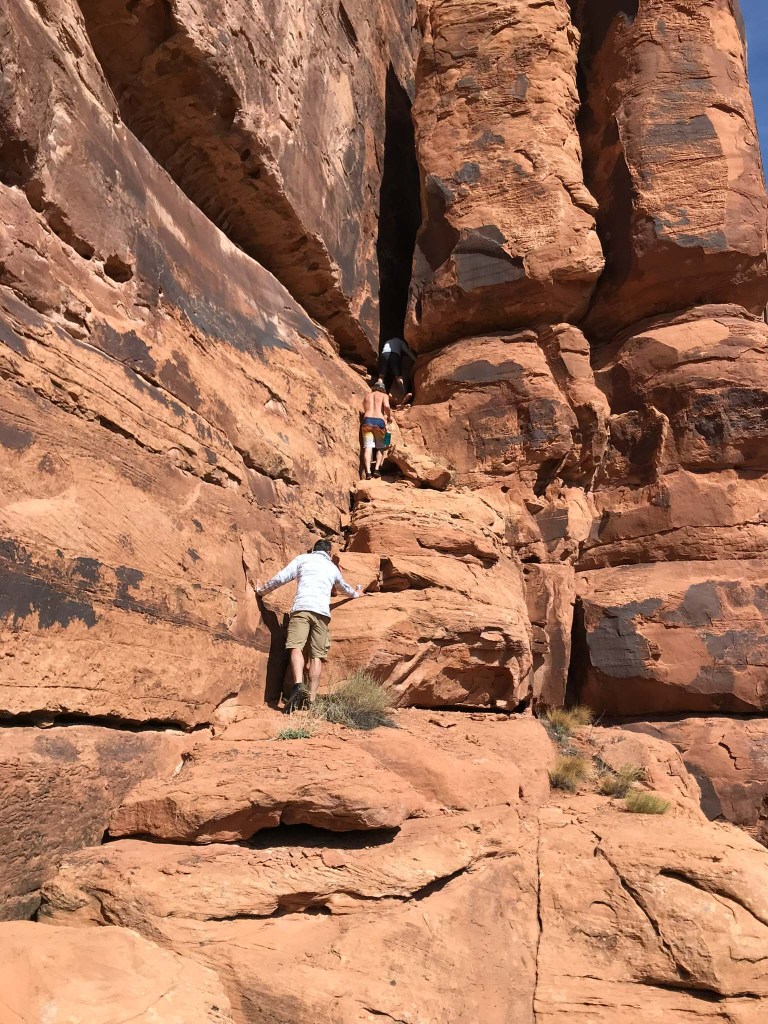
When through the rapids, it is 9 miles of flat water that is scenic and peaceful. Some side hikes are available during this section and we made sure to take advantage of one of them.
Summary
My only critique of this rafting trip through Westwater Canyon is that it is of such high quality that I was very sad to have to take out after only two days and one night on the river! I could have spent a week there!
I guess I’ll just have to go back to do this badass trip rafting Westwater Canyon again!
Email us at info@slackwaterco.com if you have any questions or need more BETA!
And check out our article on the Rocky Mountain Rafts Phat Cat for more details on why we absolutely love this boat.
Thanks for reading.
Dan
Note to the reader: Flash floods in a canyon don’t occur every time there’s a storm, but they are incredibly dangerous and quick moving when they do. Before choosing your campsite, and specifically choose where you are sleeping, examine the terrain for evidence of previous flash floods and run off to better your chances of having a safe and enjoyable rest.