

Any beginner needs these 12 basic items in their fly fishing setup. In this article, we’ll describe in detail the best fly fishing gear for beginners and recommend hand-picked, guide-recommended products.
We believe that beginner fly anglers should invest enough in their gear to be confident that it will last for years and withstand heavy use, but not spend too much, either.
As such, we only recommend products we’ve tested ourselves and believe in that are the most affordable high-quality products available.
This post may contain affiliate links, meaning Slackwater earns a commission for the referral if you decide to make a purchase through the links, but your price stays the same. Even if you click through to buy wading boots and you end up buying a fly rod, we earn a commission. We thank you for supporting Slackwater!
Best Gear for a Starter Fly Fishing Setup
Here you’ll find our hand-picked list of gear for a comprehensive beginner fly fishing setup. All items have been gear tested and reviewed by our writers at Slackwater, who are, in fact, Colorado fly fishing guides.
All items can be found on Amazon to make your shopping experience simple. If you’d like to know more about each product, continue scrolling through this article to find in-depth discussions on why we’ve recommended them, or click the green Read Review button below each product.
Guide Picked Fly Fishing Gear for Beginners
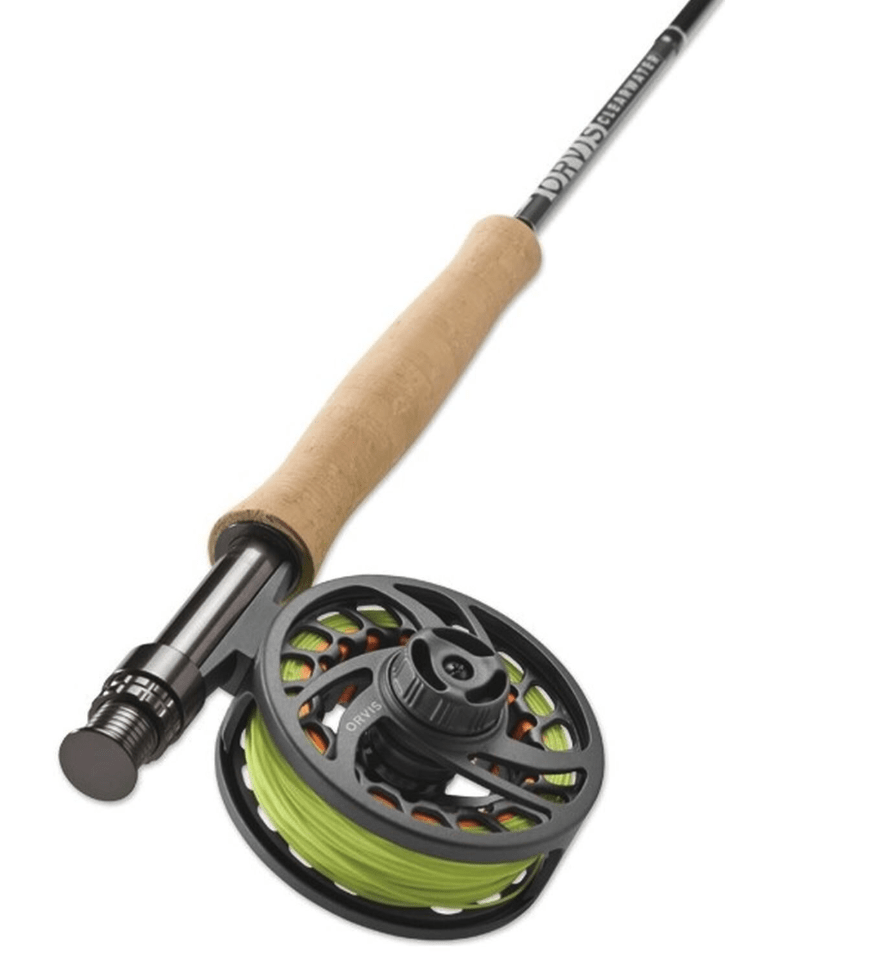


Orvis
Clearwater Outfit
Rio
Powerflex Leader
Rio
Powerflex Tippet

Pescador
Mag Pad
Fly Box
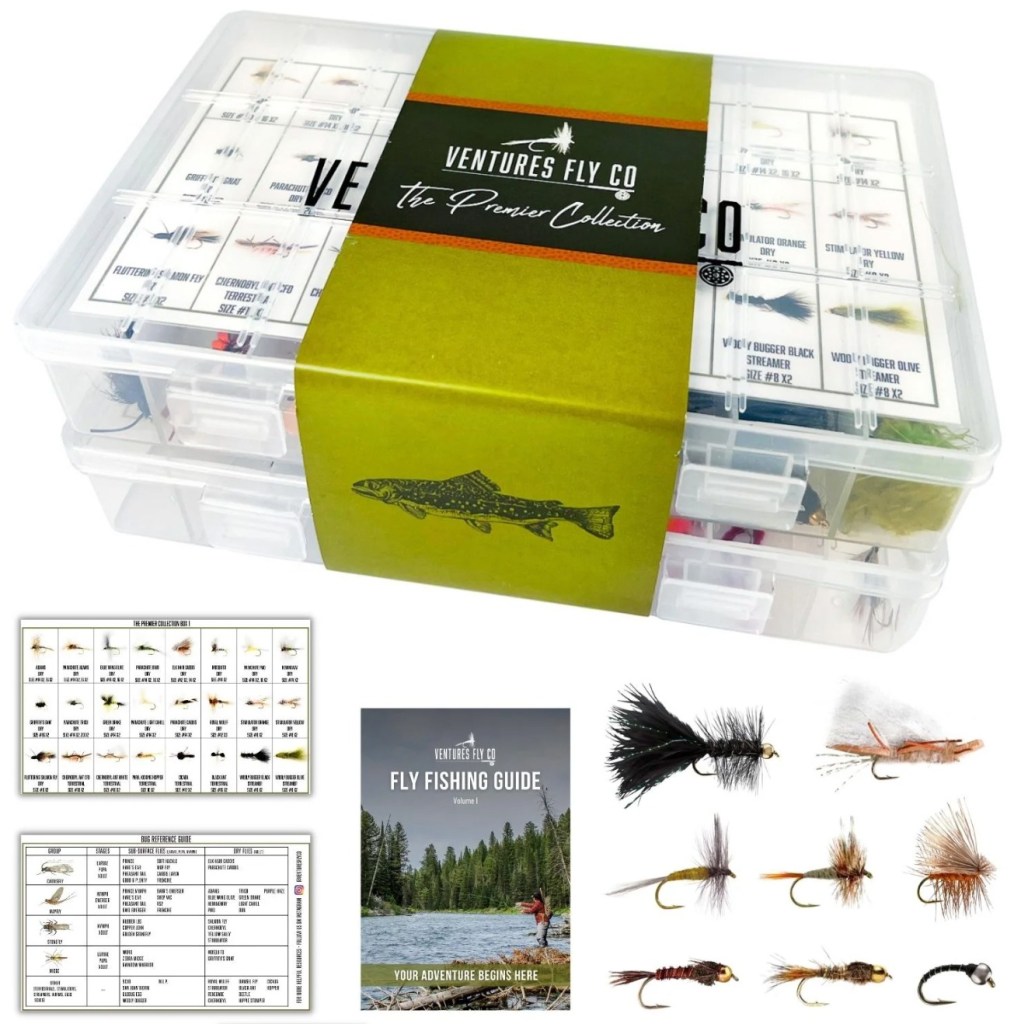
Ventures
Fly Co
Assortment
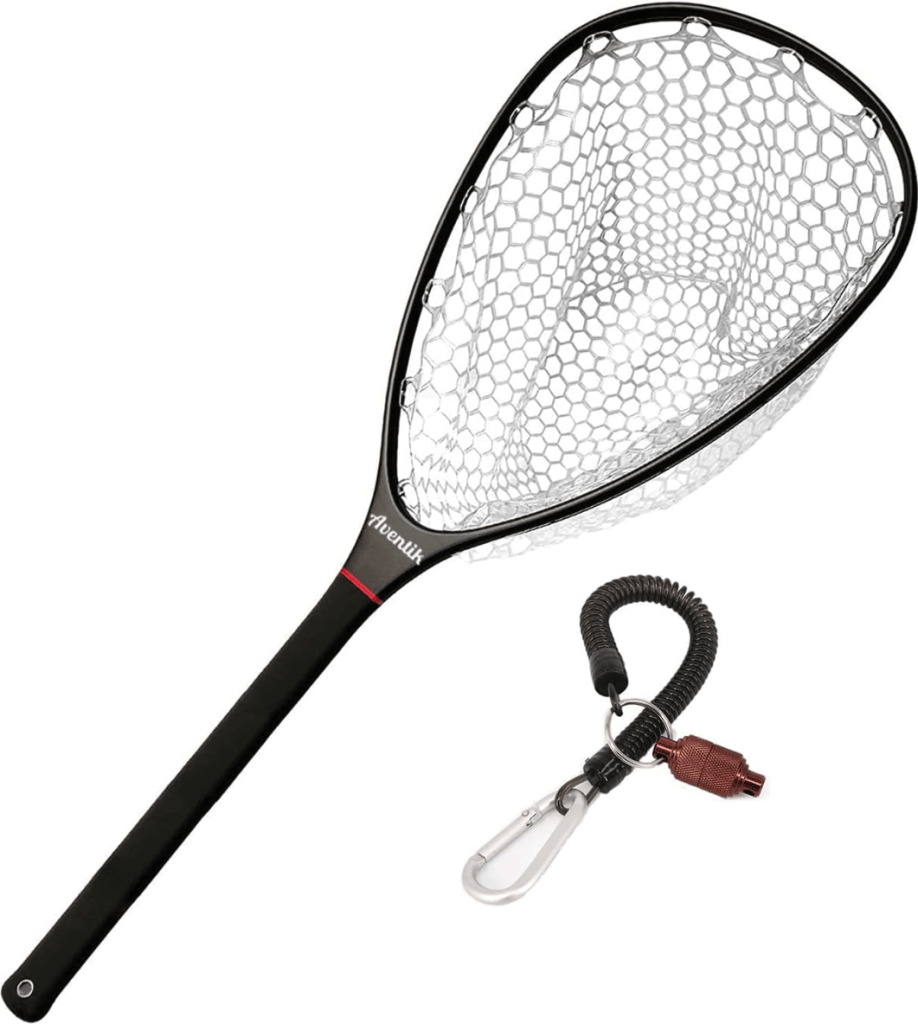
Aventik
Floating Fly
Fishing Net


Simms Freestone Pack
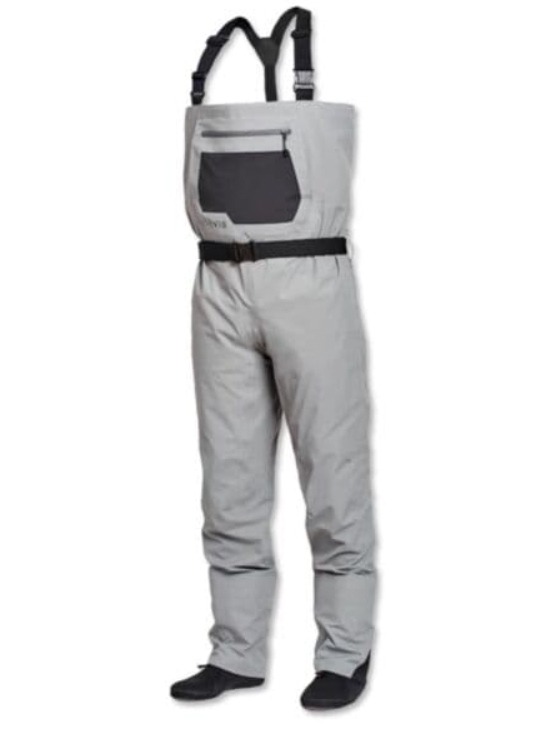
Orvis Clearwater Waders
Simms Tributary Boots
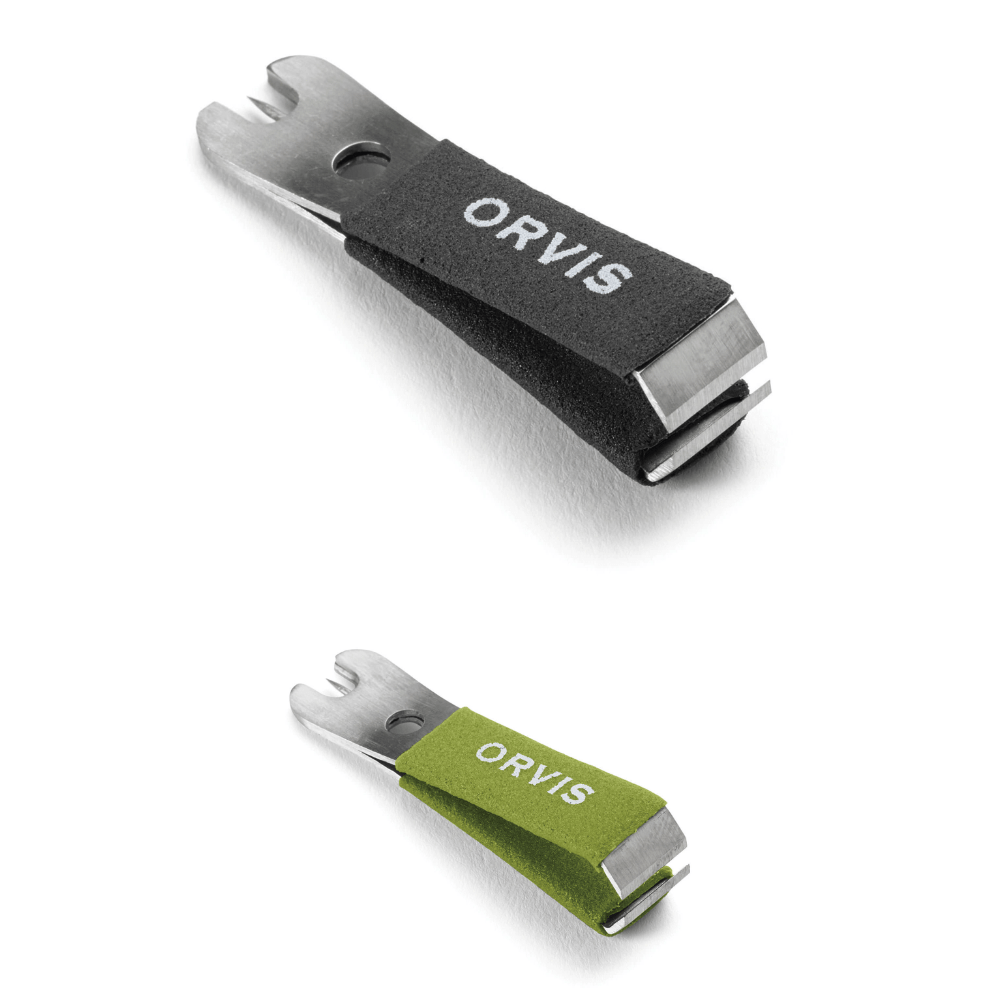


Orvis Comfy Grip Nippers
Dr. Slick Forceps
Air-Lock Strike Indicators
Beginner’s Fly Fishing Gear Review
These are the essential pieces of fly fishing gear beginners need to start their angling journey, along with Slackwater’s in-depth review of each product.
Click any of the items below to jump to a section for our recommendations, including descriptions of what the gear is used for and why we picked each item.
A Beginner’s Fly Fishing Setup
A beginner’s fly fishing setup will include the following essential pieces of gear:
- Fly Rod Outfit (Rod, Reel, & Line)
- Leaders & Tippet
- Fly Box
- Flies
- Fly Fishing Net
- Fly Fishing Bag
- Waders & Boots
- Forceps
- Nippers
- Indicators
While many anglers will possess more gear than what is listed above, the 10 items listed are the basic pieces of gear you need to be successful as a beginner fly fisher.
Let’s discuss each piece of gear, starting with a beginner fly rod outfit.
Fly Rod Outfit: Rod, Reel & Line

The basics of a beginner’s fly fishing setup start with building out a fly rod combo.
A fly rod outfit includes a fly rod, a reel, and a fly line. These three components pair together, allowing anglers to cast and present flies to feeding fish.
Below, we offer four recommended beginner fly rod combos to get you fly fishing quickly.
How are fly rod setups different from spinner rod setups?
Fly fishing rod setups differ from conventional fishing rods in several ways. Fly rods are typically longer and more flexible than traditional fishing rods. Additionally, they are designed to cast the weight of the fly line rather than the weight of a lure. A fly reel is mounted in a different location than a conventional reel and is designed to help manage a fly line, which is thicker and heavier than a conventional fishing line.
Fly Rod Weight & Lengths
For beginners, a 9-foot, 5-weight fly rod is ideal for trout and small fish in rivers and lakes. It’s versatile for nymphs, dry flies, and streamers and one of the easiest to learn casting with. For larger fish like bass, steelhead, or saltwater species, consider a heavier rod, typically between 6-weight and 12-weight.
Understanding Fly Reels
A fly reel does more than just store your line—it’s essential for balanced casting, precise line control, and smooth fish retrieval. The reel’s drag system provides necessary resistance when a fish runs, and it also stores your backing and fly line efficiently.
To set up a fly reel, anglers will spool approximately 100 yards of dacron backing onto their fly reel first, followed by a fly line, a leader, and tippet.
How to choose your fly fishing setup?
Although rods, reels, and lines are all sold separately, we often recommend beginners buy a fly rod combo. A fly rod combo will come with a rod, a reel, and a fly line complete with backing.
Below, we’ve made recommendations for four fly rod outfits we’ve tested and approved.
Recommended Fly Rod Combos for Beginners
Best Overall Combo: Orvis Clearwater Fly Rod Outfit
Top Performance Fly Rod Combo: Sage Foundation Fly Rod Outfit
Best Budget Combo: Orvis Encounter Fly Rod Outfit
Honorable Mention Combo: Echo Lift Kit Fly Rod Outfit
Best Overall Combo:
Orvis Clearwater Fly Rod Outfit

Reasons to Buy:
Reasons to Avoid
Overall, we find the Orvis Clearwater Rod to be the finest beginner fly rod available and an excellent value for the money. It is accurate, lightweight, and versatile. It comes in a variety of weights and lengths and is backed by Orvis’ outstanding 25-year warranty.
Read our full review of the Orvis Clearwater Fly Rod here.
Best Performance Combo:
Sage Foundation Fly Rod Outfit

Reasons to Buy:
Reasons to Avoid
Best Budget Combo:
Orvis Encounter Fly Rod Outfit

Reasons to Buy:
Reasons to Avoid
Honorable Mention Fly Rod Combo:
Echo Lift Kit Fly Rod Outfit

Reasons to Buy:
Reasons to Avoid
For a more in-depth review of fly rod outfits, check out Slackwater’s full review of beginner fly fishing combos.
Leaders & Tippet
While there are several brands, varieties, and sizes of leaders and tippet available, beginner anglers shouldn’t overcomplicate things and simply acquire the basics to help them get started fishing.
Below, we recommend some basic leaders and tippet materials that will get you fishing immediately.
Don’t overthink your leader and tippet purchase – just get something that works and move on. Read on to learn what size and length of leader and tippet a beginner fly fisher should use with their first fly rod.
What is a leader? What is Tippet?
A leader is a piece of nylon, fluorocarbon, or monofilament attached to a fly line’s terminal end. Its purpose is to help anglers transfer energy from their cast smoothly, all while delicately presenting flies.
Leaders will be tapered, starting thicker where it’s attached to the fly line (the butt section) and gradually getting thinner towards its terminal end (the tippet section).
Anglers attach tippet material to the end of their leader to extend its length and life.
What Size Leader & Tippet Should You Buy?
At a minimum, beginner fly fishers should start with 9-foot leaders and 30-yard tippet spools ranging in sizes from 3x to 5x.
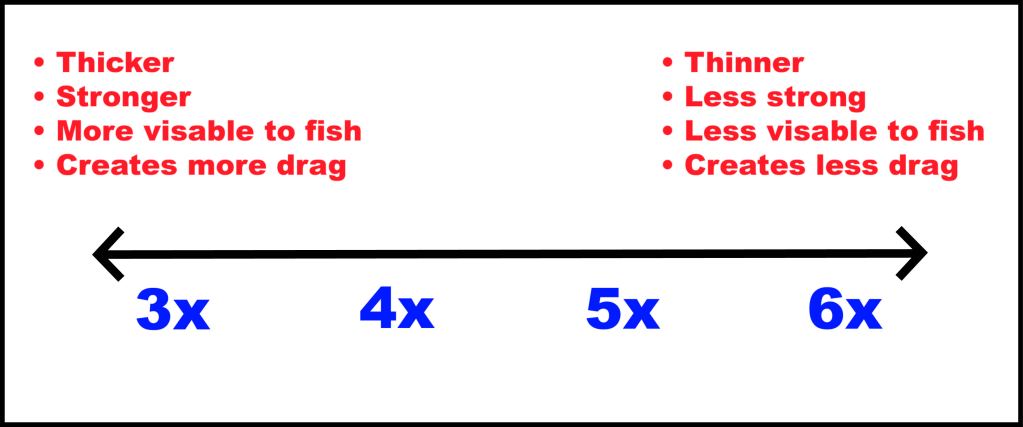
Leaders and tippet material sizes are universally measured with an “x” rating system, where the size of the material decreases as the number increases. Read more about tippet and leader sizes here.
The most common size of tippet for trout fly fishing is 4x or 5x. Learn more about tippet sizes and characteristics in our tippet size chart.
The best leader and tippet materials
We recommend purchasing nylon or fluorocarbon leaders and tippet. Here are the pros and cons of each material.
Nylon
Fluorocarbon
Learn more in our article dedicated to exploring fly fishing tippet.
Recommended Leaders and Tippet for Beginner Fly Fishing Setups
These are our recommended leaders and tippet for freshwater fly fishing. We advise most beginner fly fishers to get a 4x or 5x leader with with 4x or 5x tippet.
Rio Powerflex Plus

Rio Powerflex Tippet

Fly Box
A fly box is used to store and organize your flies and is an essential piece of fly fishing gear a beginner or advanced angler needs.
There are dozens of types and sizes of fly boxes. Some are designed specifically for streamers with large hooks, and others are designed for nymphs with very small hooks.
As a beginner fly fisher, we recommend keeping things simple by buying a fly box that will generally work for all purposes. Over time, you’ll likely want to expand your fly box collection to better stay organized.

Recommended Fly Boxes for Beginner Fly Fishing Setups
Here are three fly storage options that we use and highly recommend.
Best All Around Fly Box: Tacky Pescador Magpad Fly Box
Top Mid-Priced Fly Box: Umpqua UPG Foam Essential Fly Box
Best Simple Fly Storage: Fishpond Fly Puck
Best All Around Fly Box:
Tacky Pescador Magpad Fly Box
Reasons to Buy:
Reasons to Avoid
Best Mid-Priced Fly Box:
Umpqua UPG Foam Essential Fly Box

Reasons to Buy:
Reasons to Avoid
Best Simple Fly Storage:
Fishpond Fly Puck

Reasons to Buy:
Reasons to Avoid
Flies

No fly fishing setup is complete without a collection of artificial flies.
Selecting the best flies for your specific fly fishing application can be a complex process, and there is no one-size-fits-all approach. The best flies will vary from river to river and species to species and change dramatically throughout the day and year.
As such, it is impossible to recommend any specific fly or set of flies as a general “best choice for fly fishing.”
Instead, we will recommend a few basic fly assortments and collections, including several types of flies that will generally work well for trout fly fishing on most waters at different times of the year. As you grow as an angler, you will eventually become accustomed to some flies that work better than others and build your collection around your experience.
Three Main Fly Catagories
Most trout flies fall into three primary categories: dry flies, nymphs, and streamers. Each type of fly requires a specific technique to fish effectively.
Dry Flies
These are designed to float on the water’s surface, imitating adult insects. They are used to target trout feeding on or near the surface. We believe all anglers should have a variety of dry flies in their first fly fishing setup as a versatile imitation that catches fish on the surface.
Common dry fly patterns include:
Nymphs
These flies are designed to be fished below the surface, imitating the immature stages of aquatic insects. Nymphs are particularly effective because trout most often feed below the surface year-round. The basics of any newbie’s fly fishing setup will often include a nymph fly suspended below a dry fly in a dry dropper rig.
Common nymph fly patterns include:
Streamers
These flies imitate larger prey such as minnows and leeches. Streamers are typically fished actively with a retrieve to mimic the movement of these prey items. The use of streamers is fun but requires a completely different technique from fishing with dry flies or nymphs. We recommend most anglers start by acquiring dry flies and nymphs in their collection before attempting to fish with streamers.
Notable streamer patterns include
Recommended Flies for Beginner Fly Fishing Setups
Orvis Essential Trout Fly Selection

We love this basic selection from Orvis for two reasons: (1) it comes with a fly box, and (2) it comes with 20 time-tested, excellent fly patterns that entice a bite on nearly every trout stream.
The collection of flies contains dry flies, nymphs, and a couple of streamers to ensure that any beginner angler is set up to catch fish.
20 flies, including a fly box, for under $60, is a great value, and we highly recommend this collection.
Ventures Fly Co Fly Fishing Flies Assortment
We recommend the Ventures Fly Co Fly Fishing Flies Assortment for anglers who want to expand their fly collection quickly and have a wide variety of flies in their fly fishing setup.
This collection includes 122 top-tier flies for trout fly fishing. To make things simple for the beginner fly fisher, it includes cheat sheets describing each fly’s name and size. This is awesome for the beginner because it takes some of the guesswork out of the equation and gives you confidence in what you’re using.
This collection comes in a large box that helps you organize your flies before you put them into a smaller fly box.
Fly Fishing Net
A fly fishing net is crucial for landing fish while causing minimal harm to the animal. Made from lightweight materials and a soft, rubberized mesh basket, a net helps protect the fish’s skin and scales and is an essential piece of fly fishing gear for beginners.
The net’s design allows anglers to catch and release fish more efficiently, ensuring the fish’s survival and promoting sustainable fishing practices.
A net also helps better control the fish during the landing process, reducing the risk of losing them.
Over time, you may learn how to land a fish without a net, but in the early stages of your fly fishing journey, we recommend investing in a net as one of the essential pieces of fly fishing gear for beginners.
The best nets typically feature a long handle for extended reach and a wide, deep basket to accommodate various fish sizes. However, some anglers prefer shorter-handle nets, also known as hand nets, for packability and simplicity.
We typically don’t recommend a hand net for various reasons, discussed below, but we also know that many fly fishers make them work for small fish on small streams. Because we know some people prefer them, and because of their attractive price point, we have included one hand-net in our list, which is still a high-quality net.
Fly fishing net prices range from around $25 to over $200, but it is important to note that more expensive nets are not necessary for success.
We’ve recommended four nets in our list below, two of which are more affordable options, and two are high-end nets that cost more.
What makes a good fly fishing net?
The best fly fishing nets have the following characteristics:
The netting (aka basket) of a fly fishing net for trout MUST be made of soft, silicone-like rubber. This material is crucial in helping protect the fish from undue harm in the net. If a net is made of anything else, such as rope or string, it is not appropriate for catch-and-release trout fishing.
Further, the basket should be long enough to scoop up a large fish easily. We know that most fish caught by anglers aren’t 20 inches long, but you’ll be frustrated to have a small net when that fish of a lifetime doesn’t fit in it.
Lastly, we prefer nets with longer handles for two reasons:
- It allows for a better reach when a reach is required to net the fish
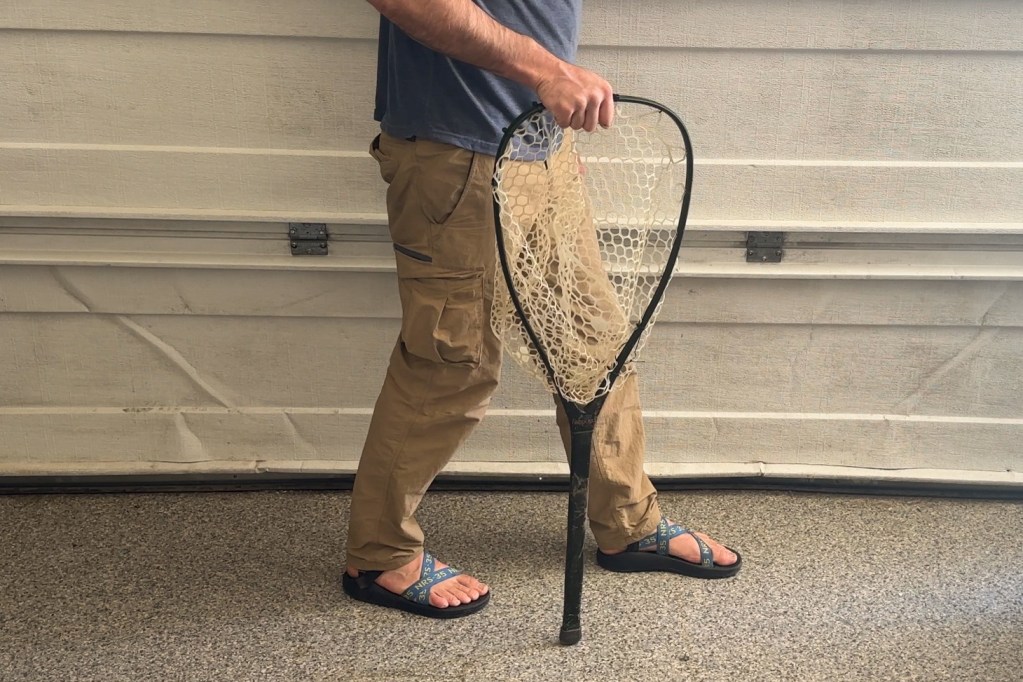
- The net can double as a wading staff when moving through slippery streambeds.
See the photos below for how we use the net as a wading staff when extra stability is required.
It’s important to note that using your net to navigate a river will quickly wear down the handle’s material.
As such, we recommend using the Fishpond Nomad End Cap if you plan on using your net to help wade. This inexpensive accessory protects the end of the net’s handle and also provides some “grip” when moving on slippery surfaces.
Using Your Net as a Wading Staff

Pictured here is the Fishpond Nomad El Jefe net.
Recommended Nets for Beginner Fly Fishing Setups
Best Fly Fishing Net: Aventik Fly Fishing Floating Net
Top Budget-Friendly Fly Fishing Net: SF Fly Fishing Landing Net
Best High-End Fly Fishing Net: Orvis Wide Mouth Guide Net
Runner-Up High-End Fly Fishing Net: Fishpond Nomad Mid-Length Net
Best Fly Fishing Net:
Aventik Fly Fishing Floating Net
We love this net because it provides the same durability, feel, and dimensions as a high-end, more expensive net from Fishpond at a price point of approximately 40% less.
In fact, through a thorough inspection, we believe this net may be made by the same manufacturer that the high-end fly fishing accessory company Fishpond uses.
While we cannot verify this assumption, it undeniably looks, feels, and performs identically. And for $70-$90 less than Fishpond’s mid-length Nomad net, we believe it is a great buy and an excellent addition to any beginner’s fly fishing setup.
Reasons to Buy:
Reasons to Avoid
Best Budget-Friendly Fishing Net
We get it—fly fishing is an expensive sport to get into, and spending $100 on a mid-length net might not be an immediate option for you.
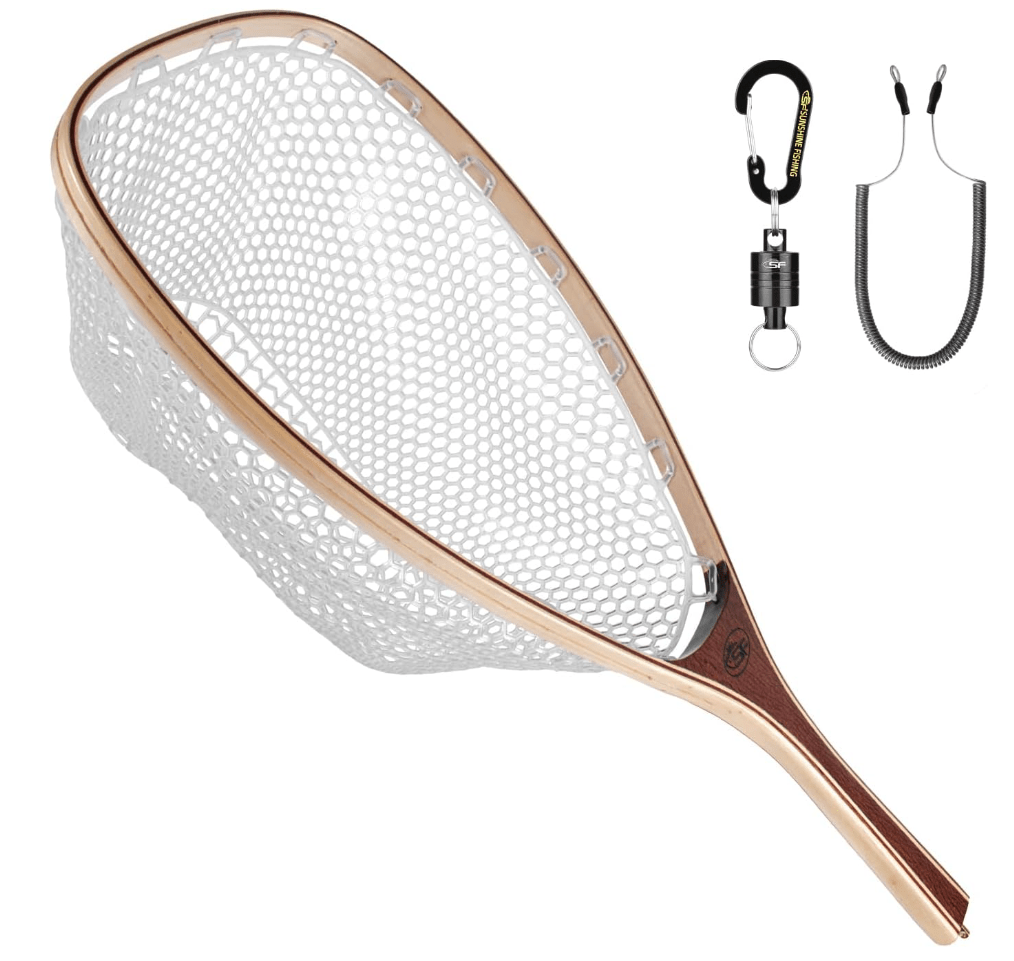
That’s where the SF Fly Fishing Landing Net comes in.
At under $40, we find this to be the best beginner fly fishing net available. It still has the most important qualities: It is made from a durable wood frame and has a rubberized basket to help protect the fish.
Reasons to Buy:
Reasons to Avoid
Best High-End Fly Fishing Net:
Orvis Wide-Mouth Guide Net

If money isn’t a consideration and you simply want the best, the Orvis Wide-Mount Guide Net is the best choice for all-around fly fishing. It’s built by Orvis, which undeniably means it’s of high quality and is backed by unparalleled exceptional customer service.
We love this net for several reasons, detailed below.
Reasons to Buy:
Reasons to Avoid
Runner-Up High-End Fly Fishing Net:
Fishpond Nomad Mid-Length Net

It’s tough to argue with the quality and craftsmanship of Fishpond’s products. They work wonderfully, look good, and can be found in nearly every fly shop. We have personally owned several of their nets over the years and have been delighted with all of them.
The only two downsides of this net are (A) the price, which is $70-90 more than Aventik’s net (which appears to be identical), and (B) the rubber basket of the net tears more easily than Orvis’ Wide Mouth Guide Net.
NOTE: Tears in a rubber basket can be repaired, but having to repair a net multiple times a season due to tears caused by sharp branches can get annoying.
To be fair, Orvis’ net is the only net in our line-up with a super durable rubber basket—and you pay good money to have that kind of quality product.
Reasons to Buy:
Reasons to Avoid
Fly Fishing Packs & Bags
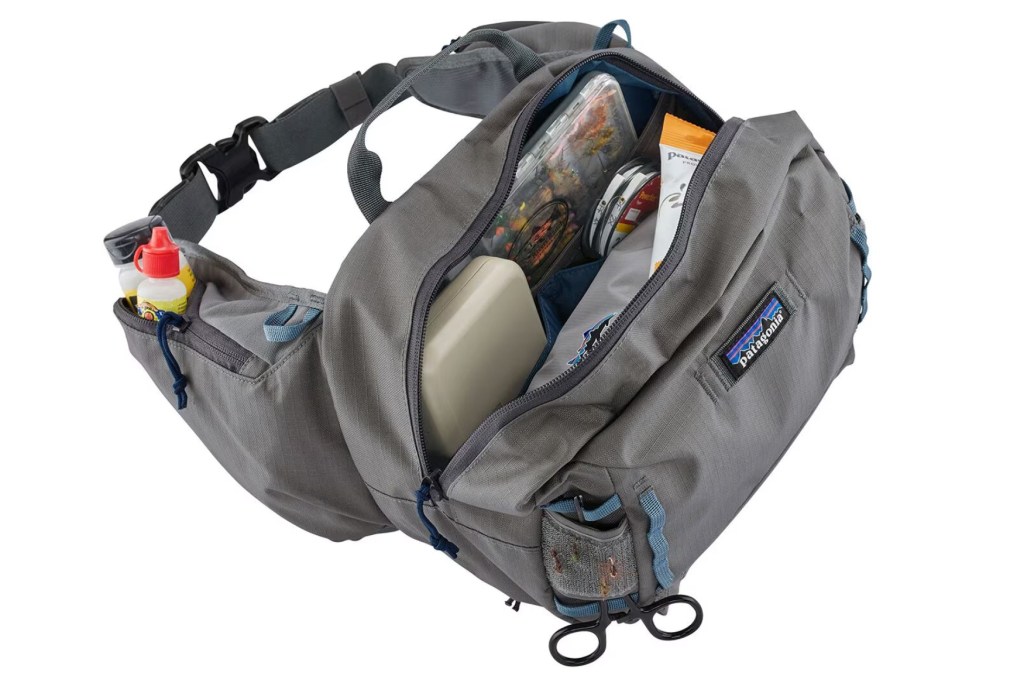
There are dozens of methods for carrying your fly fishing gear, including packs, slings, and vests. However, for beginner anglers, we recommend one style of bag: a hip pack.
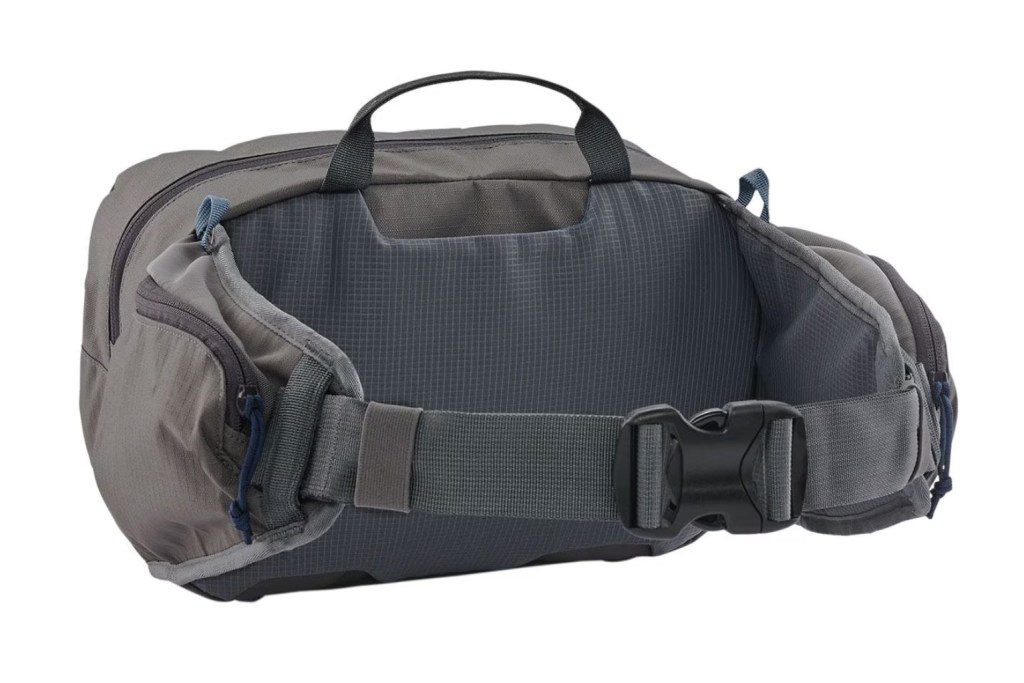
A hip-pack fly fishing bag rests on your hips and is secured by a waistband and a shoulder strap, making it a secure and functional way to store your fly fishing gear.
We like these bags because they are large enough to hold all the gear you need but small enough to prevent them from becoming a bottomless pit of stuff. Further, they are comfortable, stay out of the way when fishing, and can be accessed quickly and without too much fumbling.
Additionally, hip bags offer an excellent way to store your net when casting and changing flies.
We acknowledge that the items you need to begin fly fishing can feel expansive (and expensive). Thus, it is perfectly acceptable to use an old backpack or fanny pack for now!
If that’s the case, we encourage you to ensure that whatever pack you use is comfortable and has a robust zipper system to keep your gear secure.
Types of Fly Fishing Bags
Besides the hip bag, other styles of fly fishing bags include:
- Chest packs
- Slings
- Backpacks
- Vests
All types of on-person bags and packs have their pros and cons.
For instance, backpacks are great for storing lots of gear, including extra layers and possibly an extra fly rod. A downside is you have to take a backpack off to access your gear.
Vests are convenient and contain many pockets for organization, but an angler often gets overly warm with a vest on the hottest days. Further, vests typically don’t come with a great net-carry function.
A hip bag, nevertheless, performs well in most applications without too much sacrifice.
Are waterproof fly fishing bags necessary?
Submersible, waterproof fly fishing bags are currently a hot trend in the market. With one of these bags, your gear is completely shielded from the elements and will stay dry if submerged.
We love the feature but find it rare that a waterproof bag is necessary. Nevertheless, there are times when it is helpful:
- When fishing in the rain regularly
- When wading through belly-button deep water
- When you (gulp) accidentally take a spill in the river.
Unless you are a beginner who fishes in rainy weather regularly, we recommend saving your money and buying a non-waterproof bag.
Recommended Packs for Beginner Fly Fishing Setups
Here are our top choices for fly fishing hip packs, including two standard bags and two waterproof bags.
Best Fly Fishing Bag: Patagonia Stealth Hip Pack 11L
Runner-up Fly Fishing Bag: Simms Freestone Hip Pack
Best Waterproof Fly Fishing Bag: Fishpond Thunderhead Lumbar Submersible
Runner-up Waterproof Fly Fishing Bag: Orvis PRO Waterproof Hip Pack 10L
Best Fly Fishing Bag: Patagonia Stealth Hip Pack 11L

Reasons to Buy:
Reasons to Avoid
Runner-up Fly Fishing Bag: Simms Freestone Hip Pack


Reasons to Buy:
Reasons to Avoid
Best Waterproof Fly Fishing Bag: Fishpond Thunderhead Submersible Lumbar Pack


Reasons to Buy:
Reasons to Avoid
Runner-up Waterproof Fly Fishing Bag: Orvis Pro Waterproof Hip Pack


Reasons to Buy:
Reasons to Avoid
Waders & Wading Boots
Wading gear allows an angler to fly fish while standing in the water, all while staying dry and warm. As such, waders and boots are essential pieces of fly fishing gear any beginner angler needs.
Fly fishing waders are required when the water is particularly cold or during the colder months of the year.
If you are an angler who only fishes when the water is cold and the air is hotter, you may get away with wet wading, which is when an angler is okay with standing in the water and getting soaked.
Otherwise, we recommend beginner fly fishers choose a set of waders and boots from a reputable company with a solid repair/warranty program.
Companies Who Make the Best Waders for Beginners
These three companies make waders and wading boots geared toward the beginner angler’s commitment to the sport and to saving money.
Each of these brands makes awesome products and will help you repair them, even if they’ve worn down over time due to excessive use or natural breakdown of materials.
We also love Patagonia’s waders and boots. However, most of their waders and boots are more expensive and cater to more advanced fly fishers or people without budgetary concerns. But, damn, they are solid if they fit into your budget!
What’s Better: Chest or Hip Waders?
Fly fishers use a couple of different wader styles, including chest and hip waders.
If a chest wader will work for you, we highly recommend going that route.
We often recommend chest waders because they have more pockets and will be more versatile over time, allowing the fisherperson to access deeper waters. Additionally, chest waders will have more pockets and ways to secure your accessories.
Hip waders are suitable for casual anglers who only wade into the water up to their knees. They are also typically more comfortable for plus-size fly fishers who are more comfortable with apparel that terminates below the waistline.
Wader Sizing
You need a set of waders and boots that fit your body type (height, waist size, shoe size).
The more you spend on waders, the more size options you’ll have. For instance, less expensive waders will come in sizes XS to XXL, matching approximate height, waist size, and shoe size to the general population.
More expensive waders will allow you to pick your size (overall mass and waist size), length (aka your height, ranging from short to long), and boot size for your foot.
A perfect, tailored fit for your waders isn’t crucial. Still, your waders should provide good freedom of movement (including the ability to bend over and kneel), a comfortable fit for your feet, and a few pockets for storing your belongings.
If you’re questioning what size to get, err on the side of caution by choosing a size up rather than a size down. In general, waders a touch too large can still work for you while waders too small will be uncomfortable and limit your range of movement.
And when you’re not comfortable, you won’t fish as well.
How Much Should You Spend on Fly Fishing Waders?
For beginner anglers, waders and boots are typically among the most expensive elements in their fly fishing tool chest. While a high-quality product at an affordable cost should absolutely be a consideration, we don’t buy the least expensive or the most expensive product.
Instead, we recommend starting your search for waders in the $150-$400 range and boots in the $150-$250 range, primarily from Simms, Redington, and Orvis.
That being said, you’ll probably be in the $300-$500 price range (at a minimum) for some solid gear that will last you for years.
If your budget doesn’t allow for that investment yet, we’d encourage you to wet wade for the time being and save up for a quality product rather than buying cheap waders and boots that will require replacement too soon. And if your budget allows for a more expensive wader that is more custom-fitted to your body, we like the Swiftcurrent Wader from Patagonia and G3 Guide Stockingfoot from Simms.
Buying Waders Online or in a Fly Shop?
While we would love (and appreciate) any reader choosing one of the products recommended below (because we may earn a small commission on the sale), we highly recommend that new anglers visit a fly shop and try some waders and boots on in person.
In a fly shop, you’ll get access to professional anglers who know the sport well and fly fishing gear better. These people will be able to help you find the perfect wader for your body style with a boot to match. The only downside to a fly shop is they likely won’t have all brands and models, which may result in limited choices.
Otherwise, here is our list of recommendations for the best fly fishing waders and boots for beginners.
Recommended Waders & Boots for a Beginner Fly Fishing Setup
Waders
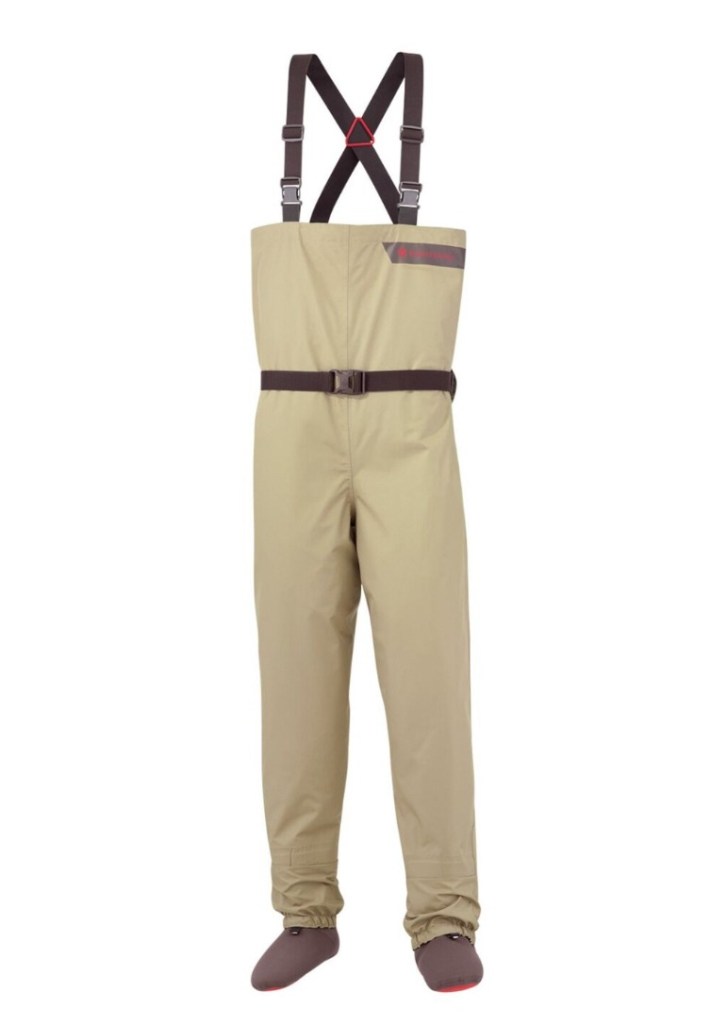
These are three solid fly fishing waders that are great for beginners. Our overall pick is the Orvis Clearwater Stockingfoot Wader due to its craftsmanship, well-thought-out design, and its price point.

Overall Best Wader
Orvis Clearwater Stockingfoot Wader
Runner-Up Wader
Simms Freestone Stockingfoot Wader
Best Budget-Friendly Wader: Redington Crosswater Wader
Why to Buy:
Reasons to Avoid
We couldn’t think of any reasons to avoid buying these. The price is affordable, the sizing is spot on, the features are that of a higher-end wader, and it’s backed by an Orvis Warranty.
Why to Buy:
Reasons to Avoid
Why to Buy:
Reasons to Avoid
Wading Boots
The most important quality in wading boots is that they are comfortable when standing. They do not need to be comfortable to walk in for long distances unless you plan on doing adventure fly fishing in backcountry trout streams.
While we’d love to recommend boots from different brands, we find ourselves continuously returning to the Simms lineup and sticking with it. Simply put, some companies seem to get a certain niche of fly fishing gear right — Simms is our choice for that company.
Additionally, the more you spend, the more you will typically get out of your boot. However, for the beginner angler, we know that budgets are tighter, so we’ve chosen wading boots that cater to those who are most cost-conscious.
The two wading boot offerings recommended below have been tested for approximately 40 days each and have (substantially) withstood good abuse.
Read more below.


Overall Best Wading Boot Simms Tributary Wading Boot
Runner-up Best Wading Boot Simms Freestone Wading Boot
Why You Should Buy:
Reasons to Avoid
Why You Should to Buy:
Reasons to Avoid
Forceps, Nippers & Indicators
For the remaining items in our list of beginner fly fishing gear, we advise anglers not to give things too much thought and simply buy something that works.
Inexpensive, mid-range, and expensive forceps and nippers will all do the job just fine. As an angler, you will determine what type of indicators you enjoy using most over time, which may or may not be different than what I use.
With this all being said, we advise you to get something that is budget-friendly and will not be too upsetting when you inevitably lose the item someday.
Below is our list of what we like to use, but we also know there are several comparable options in the fly fishing market.
Buy what works for you and your wallet!
Recommended Forceps for Beginners
Forceps (aka hemostats, aka mini-pliers) are used to unhook your fly from a fish’s mouth. You’ll use them regularly when the hook is lodged deep in the fish’s mouth or when the fly is too small to grab with your fingers.
Fly fishing forceps range from $5 to $180. However, we like the ones in the $15-$25 range to accompany a budget-friendly fly fishing setup. They are light on the wallet, and they work very well.
Further, the most inexpensive forceps generally lose clamping strength over time, especially when they are dropped or mishandled. Forceps for around $20 or more won’t do that and will last for years.
Here are our recommendations:
Dr. Slick Mitten Scissor Clamp
What we like
What we don’t like
Nothing. These are great forceps.

Loon Rogue Forceps
What we like
What we don’t like
Nothing. These are great forceps.
Recommended Nippers for Beginners
Nippers serve one purpose when fly fishing: to trim the tippet after tying on a new fly. A simple yet important task.
The problem with nippers is that YOU ARE going to lose them someday, and they really aren’t worth investing much money in. Since a $10 pair of nippers technically works just as well as a $150 pair of nippers, we see absolutely zero reason to splurge.
To avoid losing your nippers, we recommend using a zinger attachment or a lanyard. Personally, we like a lanyard best, but there is no one wrong method.
Here are two nippers that we use regularly and do the job perfectly. There is nothing about these recommended nippers that are bad.
Orvis Comfy Grip Nippers

Loon Rogue Nippers
Recommended Indicators for Beginners
Fly fishing indicators are used as a visual aid to help anglers detect when a fish has taken their nymph. Indicators look and feel like bobbers used in conventional spinner fishing.
Indicators are a minute yet essential piece of fly fishing gear that any angler needs in their fly fishing setup.
There are dozens of styles of indicators. However, the ones recommended below are the ones we most frequently use when guiding fly fishing clients.
These bobber-style indicators are easy to rig up or take off, which is different from more advanced indicator styles such as the Dorsey Indicator, or a New Zealand Style Indicator. These aforementioned indicators work very well, but they take more practice to use. Therefore, we recommend bobber-indicators as one of the better pieces of fly fishing gear for beginners.

OROS Strike Indicators

Air-Lock Strike Indicators
SUMMARY of Best Beginner FLy Fishing Gear
There are dozens of items people are going to tell you that you need to be a successful fly angler. While this mantra may be true in some circumstances, the items discussed and recommended are the only essential pieces of gear you need in a fly fishing setup.
The best fly fishing gear for beginners is not always the most expensive or inexpensive—it is generally somewhere in the middle. It is comprised of items made by reputable companies and will last for years.
If you didn’t find what you were looking for in our list above, email us at info@slackwaterco.com, and we will be happy to help you find it!
Thanks for reading.