Fighting and netting a fish running downstream of you is one of the most challenging things to do in fly fishing. This is especially true when it’s a big, feisty fish.
So, how does an angler bring that fish to the net quickly and safely? The answer: Like anything in fly fishing, it depends.
Let’s take a quick look at a scenario many of us have faced:
A fish takes your nymph fly two seconds after you’ve cast your rig at a 45-degree angle upstream and across the stream.
You set the hook downstream because, more likely than not, the fish is facing upstream. A downstream hookset will give you the best chance of lodging the hook in the fish’s mouth. After setting the hook, you rotate your rod upstream and apply side pressure to get the fish out of its lane and bring it towards you.
And then. The fish runs hard and fast downstream.
What do you do?
This is when we need to think quickly and make smart decisions. But first, let’s dig into why fighting a downstream fish is the worst.
Why Fighting a Fish Downstream is Bad
First, when a fish runs downstream, you must let it run so as not to break off. This means you have to let the line off your reel.
When there’s more line on the water, you have less control over the fight. Less control over the line means there’s a higher probability of you losing a tight-line advantage on the fish, and it gets off the hook.
Second, it’s tough to put upstream-side pressure on a fish when it’s downstream of you. Throw in the likeliness of the river having boulders and mixed currents, and controlling the fish becomes quite challenging.

Third, when a fish is downstream of you, the chances of you pulling the hook out of its mouth skyrocket. Again, fish will fight facing upstream a lot of the time.
When we are pulling upstream, the hook frequently will dislodge.
When fighting a fish upstream of you, keeping a tight line and bringing the fly line in is easier, either through stripping or reeling. Additionally, you can apply side pressure on the fish to methodically pull him out of his lane into a zone where he can be netted.
How Do You Fight a Running Fish?
The first option to fight a running fish is to get a move on and head downstream with the fish. Do everything you can to get below (downstream) of the fish to fight him upstream of you.
(1) If the fish is running fast, you should get there faster.
If you can safely get to shore and move downstream with the fish, that is frequently your best option since humans move faster on land than while wading.
While time is of the essence, doing this safely and methodically is most important. If you slip and fall during this maneuver, you’ll likely lose the fish anyway and can put yourself in a dangerous position.
Do your best to keep tension on the fish with your rod close to the water’s surface while moving downstream.
Keeping your rod low will help keep the fish under the water instead of jumping. A jumping fish can more frequently unhook itself than a fish fighting underwater.
This is a great video from Tom Rosenbauer discussing what he does when he needs to land a fish that’s downstream.
Unfortunately, in many cases, you’re wading in fast water and are standing on a slippery river bed. This may mean getting to shore and moving downstream safely isn’t an option.
So, your next best option will be to rotate your rod downstream (towards the fun running) and apply downstream side pressure.
(2) Keep your rod tip low and the fish in the water.
Keeping your rod tip low helps keep a running fish under water. Further, this helps you apply side-pressure to the fish rather than upward pressure.
Again, pulling on the fish directly upstream will often result in losing the fish.
In Summary
Fighting a running fish is a skill set that many fly anglers struggle with if they don’t have enough practice. At the end of the day, losing a bunch of fish that run downstream is one of the best ways to get better at landing the big ones.
Team Slackwater.
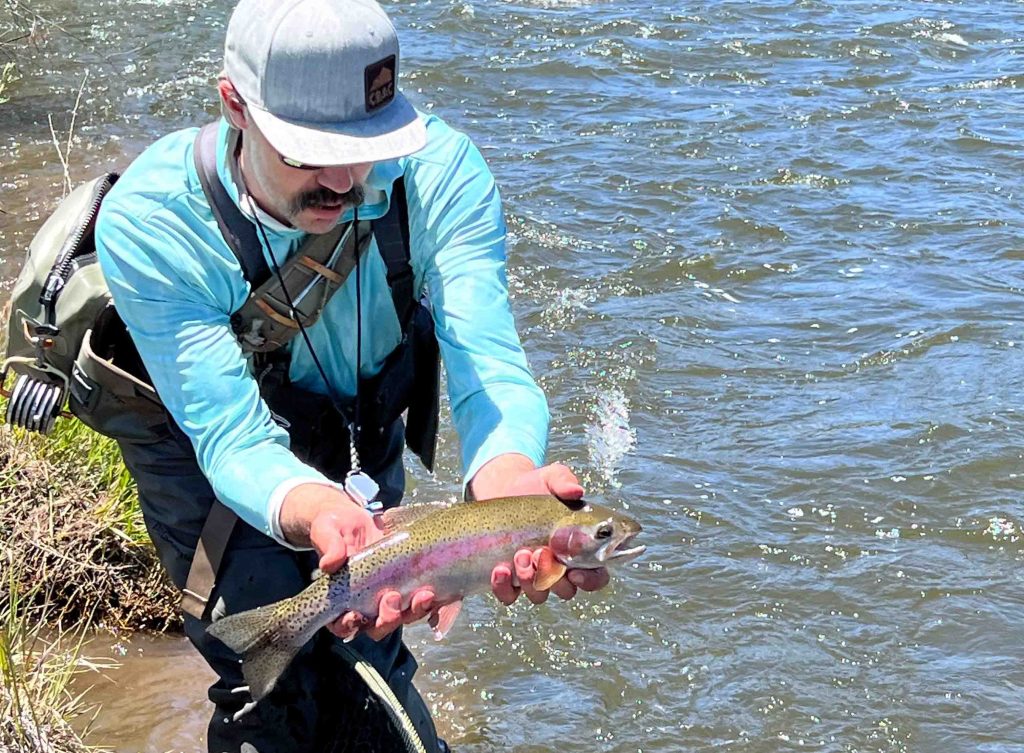
Featured Image: This is a photo of Dan Jones, Crested Butte Fly Fishing Guide, with a decent sized Rainbow trout from the Gunnison River. This fish wasn’t the largest fish of the day, but it was surly and ran quickly downstream after it was hooked. In order to bring the fish to the net, Dan moved quickly with the fish until he could get downstream of it.